Following a historic Europa League triumph under Unai Emery and a fourth-place Premier League finish that secured Champions League football for a second time in three seasons, Aston Villa enters 2026/27 in the midst of a major squad transition. This is the definitive guide to the current Villa squad.

Technical Leadership & Coaching Profile
Manager: Unai Emery
Emery enters his fifth season at Villa Park having cemented his reputation as one of Europe’s elite cup managers. The Spaniard’s Europa League triumph last May — his fifth in the competition — was the club’s first major trophy in 30 years. A former midfielder with Real Sociedad and Toledo, Emery has now won the Europa League with four different clubs and led Villa to the Champions League quarter-finals in 2024/25. His meticulous preparation and tactical detail remain the foundation of Villa’s remarkable overperformance since he inherited a side 14th in the table in November 2022.
Tactical Philosophy
Emery has consciously evolved Villa’s midfield profile this season, moving toward a more combative double-pivot following the arrivals of João Gomes and Leon Goretzka. Gomes has immediately justified the £38m investment from Wolves, leading the Premier League in tackles per 90 minutes at 6.2. The structure remains king for Emery, but he has shown willingness to grant freedom to exceptional talents, already contemplating offering Johan Manzambi licence to express himself in a manner comparable to how Morgan Rogers was unleashed. Defensively, Villa have struggled for consistency, conceding 10 goals in their opening five league matches before the Tottenham win.
Preferred Formations
4-2-3-1 / 4-4-2 in possession.
Strategic Transfer Activity
Villa’s summer was defined by financial necessity as much as ambition. UEFA’s Squad Cost Ratio limits forced the sales of Morgan Rogers (£117m to Chelsea) and Youri Tielemans (£35m to Manchester United), while Ollie Watkins departed for Al-Hilal in a £51m deal. The club reinvested in younger assets, with Nicolas Jackson arriving as Watkins’ replacement in a club-record £65m deal.
Table A: Summer Major Transfer Influx
| Player | Position | Former Club | Fee Paid |
|---|---|---|---|
| Nicolas Jackson | Striker | Chelsea | £65m (club record) |
| Johan Manzambi | Attacking Midfielder | Freiburg | £50m+ |
| João Gomes | Central Midfielder | Wolves | £38m |
| Zion Suzuki | Goalkeeper | Parma | Undisclosed |
| Taylor Harwood-Bellis | Center-Back | Southampton | Undisclosed |
| Matteo Ruggeri | Left-Back | Atalanta | Undisclosed |
| Alejandro Garnacho | Winger | Chelsea | Loan (obligation to buy) |
| Aaron Wan-Bissaka | Right-Back | West Ham | Undisclosed |
| Ibrahim Mbaye | Right Winger | Paris Saint-Germain | £47m |
| Victor Lindelöf | Center-Back | Manchester United | Free |
| Leon Goretzka | Central Midfielder | Bayern Munich | Free |
The First-Team Roster
Goalkeepers
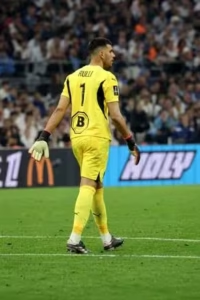
Zion Suzuki (#1): The Japanese international has been a revelation since arriving from Parma, immediately relieving concerns that replacing Emiliano Martínez would represent a downgrade. Suzuki’s distribution has become a genuine weapon, with his 25.3 accurate passes per 90 minutes bettered by only three goalkeepers in the Premier League. He pinged accurate long balls and punched passes into attackers during an impressive debut against Arsenal, and his comfort with Emery’s demands suggests a long-term solution.
Marco Bizot (#40): The experienced Dutch goalkeeper provides reliable backup coverage for domestic cup and European rotations. His professionalism adds a steadying presence to the goalkeeping group.
James Wright (#42): The academy graduate continues his development as third-choice option, gaining valuable exposure to first-team standards.
Defenders
Matty Cash (#2): The Polish international remains Villa’s first-choice right-back, his energy and overlapping runs a consistent feature of Emery’s attacking structure. Now approaching 200 appearances for the club, his experience is invaluable within a transitional squad.
Victor Lindelöf (#3): The Swedish free-agent arrival from Manchester United brings Champions League pedigree and composure to the defensive core. At 32, his reading of the game and passing range provide the experience Emery values as younger defenders integrate.
Taylor Harwood-Bellis (#4): The summer arrival from Southampton represents a long-term investment in the heart of defence. At 24, the England international’s ball-playing ability and aerial presence make him a natural fit for Emery’s build-from-the-back principles.
Tyrone Mings (#5): The veteran center-back remains a vocal leader and physical presence, though injuries have limited his availability in recent seasons. When fit, his aggression and aerial dominance provide a robust option.
Pau Torres (#14): The Spanish center-back’s left-footed passing range and composure make him Villa’s most technically gifted defender. His partnership with Harwood-Bellis is likely to be the preferred pairing once fully integrated.
Matteo Ruggeri (#13): The Italian left-back arrived from Atalanta to provide competition and cover on the left flank. His attacking thrust and tactical intelligence suit Emery’s demanding wing-back profile.
Ian Maatsen (#22): The Dutch left-back offers pace and directness from wide areas, his overlapping runs adding an attacking dimension. His development under Emery’s guidance continues to progress.
Aaron Wan-Bissaka (#29): The summer signing from West Ham provides defensive solidity at right-back, his tackling statistics already ranking among the Premier League’s best. His presence allows Emery to rotate Cash without dropping the defensive baseline.
Midfielders
Boubacar Kamara (#8): Described by captain John McGinn as “one of the best midfielders in Europe,” the Frenchman is Villa’s quiet, modest star. Since arriving from Marseille in January 2022, Villa’s win percentage with Kamara approaches 60%, compared to 40% without him. His ability to execute simple actions perfectly and elevate those around him makes him indispensable.
João Gomes (#35): The Brazilian arrived from Wolves for £38m and has immediately established himself as the Premier League’s most prolific tackler, averaging 6.2 tackles per 90 minutes. His ball recoveries ranked fourth in the division last season, adding crucial bite alongside Kamara. A red card on the opening weekend for violent conduct served as a reminder of his combative edge, but his ability to progress the ball — demonstrated by an assist against Club Brugge — makes him a complete midfield package.
John McGinn (#7): The club captain and heartbeat of the squad, his leadership and standards-setting influence anchoring a dressing room integrating ten new arrivals. The Scottish midfielder’s energy and drive remain central to Villa’s identity.
Leon Goretzka (#27): The experienced German arrived on a free transfer from Bayern Munich, adding Champions League-winning pedigree and physical presence to the midfield. At 31, his box-to-box running and aerial threat provide a different dimension to Emery’s options.
Amadou Onana (#24): The Belgian midfielder is sidelined with a serious knee injury, leaving a significant void in Villa’s athletic midfield depth. His eventual return will provide another combative option alongside Gomes and Kamara.
Ross Barkley (#6): The experienced English midfielder provides reliable depth and tactical intelligence, his passing range and shooting from distance offering an alternative creative outlet.
Lamare Bogarde (#26): The young Dutch midfielder continues his development within the first-team squad, gaining exposure to Emery’s demanding tactical framework.
Forwards
Nicolas Jackson (#11): The club-record £65m arrival from Chelsea is the direct replacement for Ollie Watkins and a player Emery has trusted since giving him his debut at Villarreal. Jackson scored 30 goals in 81 appearances for Chelsea and spent last season on loan at Bayern Munich, helping the German giants win the Bundesliga with a 21.1% conversion rate. His pace and movement offer a different profile to Watkins, and his first Villa goal at Tottenham will have relieved early pressure.
Johan Manzambi (#44): The marquee summer signing from Freiburg, arriving for a club-record fee exceeding £50m after being named Europa League Young Player of the Year. The 20-year-old was one of the World Cup’s breakout stars, finishing as Switzerland’s top scorer with three goals and two assists. Emery is already contemplating granting him freedom to express himself, a testament to his exceptional talent. His goal at Tottenham demonstrated the impact he can deliver.
Emiliano Buendía (#10): The Argentine playmaker remains Villa’s creative heartbeat, his goal at Tottenham — a stunning long-range strike — showcasing his enduring match-winning capacity. His ability to unlock deep defences and contribute from midfield makes him central to Emery’s attacking structure.
Alejandro Garnacho (#17): The Argentine winger arrived from Chelsea on loan with an obligation to buy, providing direct running and creativity from wide areas. He created six big chances and earned four assists at Chelsea last season, and Emery will expect similar productivity once he adapts to Villa’s demands.
Ibrahim Mbaye (#19): The 18-year-old arrived from Paris Saint-Germain on deadline day, having become the youngest African to score at a World Cup this summer. The right winger’s pace and directness offer long-term attacking potential, and he reunites with Senegal teammate Nicolas Jackson.
Tammy Abraham (#18): The former Chelsea striker provides experienced cover in the attacking line, his physical presence and finishing instincts offering a reliable alternative to Jackson.
Brian Madjo (#39): The 17-year-old academy graduate has been promoted to the first team, earning minutes in the UEFA Super Cup against Paris Saint-Germain. His development will be carefully managed.
George Hemmings (#53): The 19-year-old academy product has been highly rated at Villa Park, with Emery calling him “clearly a Premier League player.” He started against Tottenham, underlining the manager’s faith in his potential.
Leadership Group & Squad Regulations
Club Captain: John McGinn
The Scottish midfielder remains the unequivocal leader of the squad, his voice and standards-setting influence anchoring a dressing room undergoing significant transition. McGinn’s experience of Villa’s journey from relegation battlers to European contenders provides essential perspective for the new arrivals.
The Leadership Committee
Tyrone Mings, Emiliano Buendía, and Victor Lindelöf serve as the senior voices bridging Emery’s coaching staff and the emerging core. Their combined experience across Premier League and European competition provides essential guidance.
Homegrown Quota Check
With Matty Cash, Tyrone Mings, Ross Barkley, and academy graduates George Hemmings and Brian Madjo all qualifying, Villa comfortably satisfies the Premier League’s registration requirements while maintaining their commitment to youth development.
Financial & Contractual Health
Financial Balance Overview
Villa’s summer business was shaped by UEFA’s Squad Cost Ratio rules, which limit clubs to spending 70% of revenue on transfers, wages, and agent fees. The £117m sale of Morgan Rogers was “the easiest way to comply with the regulations,” while Tielemans’ £35m departure represented pure profit on a free-transfer arrival. Emery has publicly defended the strategy, describing sums like £50m for players around 30 as “crazy” and insisting the decisions are “good for the club.” The reinvestment in younger assets — Jackson (25), Harwood-Bellis (24), Gomes (25), Ruggeri (24), Suzuki (24), Manzambi (20), and Mbaye (18) — reflects a deliberate pivot toward a more sustainable squad profile.
Contract Red Alerts
The long-term futures of key performers like Boubacar Kamara and Emiliano Buendía will require attention in upcoming windows, with both attracting inevitable interest. The integration of the new attacking core — Jackson, Manzambi, Garnacho, and Mbaye — must deliver quickly to justify the significant investment and maintain Villa’s competitive position.
The Academy Pipeline & Loan Tracker
Breakout Talents to Watch
George Hemmings (#53) has already earned Emery’s trust, starting against Tottenham and being described as “clearly a Premier League player.” His development within an evolving attacking structure will be closely monitored. Brian Madjo (#39) became one of the youngest players to feature in a UEFA Super Cup when he started against Paris Saint-Germain at 17, underlining the academy’s productivity.
Notable Out on Loan
Leon Bailey has been linked with a loan move to Hull City as Villa seek to trim their squad and create space for the new attacking arrivals.
Set-Piece Specialists & FPL Cheat Sheet
Penalties: Emiliano Buendía (First Choice) / Nicolas Jackson (Second Choice).
Direct Free-Kicks: Emiliano Buendía / John McGinn.
Corners & Crosses: Emiliano Buendía / Matty Cash.
Final Outlook: Navigating the Tactical Horizon
Aston Villa enters 2026/27 in the midst of a fascinating experiment: can Unai Emery rebuild an attacking unit almost from scratch and maintain the Champions League-level standards he has established? The evidence so far suggests a challenging adaptation period. Villa opened the season with four matches without a goal, managing just one shot on target across their first three league games. The 3-2 victory at Tottenham — secured through goals from Manzambi, Jackson, and Buendía — provided the breakthrough, but the attacking cohesion remains a work in progress.
The statistical picture is stark. Villa lost 46% of their Premier League goals from last season with the departures of Watkins and Rogers, plus 18 assists from the pair alongside Lucas Digne and Youri Tielemans. All four have gone. The new supply line — Mbaye, Garnacho, and Manzambi — possesses immense potential but limited Premier League experience. Emery’s meetings, which can last up to two hours, demand intense focus and adaptation, and integrating ten new players takes time.
Yet Emery has rebuilt Villa before. He inherited a side three points above the relegation zone and transformed it into a Champions League quarter-finalist and Europa League winner. The early signs offer encouragement: Suzuki’s distribution has been exceptional, Gomes has added a combative dimension that was missing, and the win at Tottenham demonstrated the resilience within the squad. Manzambi’s goal and Jackson’s opener will have settled nerves.
If Emery can accelerate the integration of his new attacking core, if Jackson can replicate the 21.1% conversion rate he showed at Bayern, and if the combative midfield duo of Kamara and Gomes can provide the platform for Villa’s creative talents to flourish, the club possesses the foundation to challenge for European qualification once again. The margin for error is slim, but Emery has made a habit of defying expectations. The magic may take time to reappear, but few would bet against it.