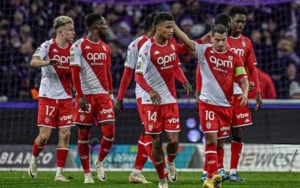
Anderlecht enter the 2026/27 season under new management at both coaching and sporting director levels, with Vítor Bruno installed in the dugout and Antoine Sibierski appointed as Director of Football. The club underwent a significant squad overhaul, with eleven new arrivals across all positions as the Mauves attempt to close the gap on Club Brugge and Union SG. The early-season results have been mixed: three league matches have produced just three points, leaving Anderlecht 11th in the Jupiler Pro League, though the Europa League qualification campaign has been navigated successfully. A new attacking philosophy under Bruno and a commitment to developing young talent have generated cautious optimism, but the margin for error in the Belgian top flight remains narrow.
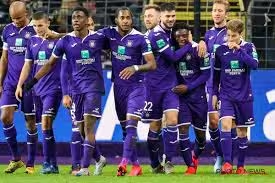
Technical Leadership & Coaching Profile
Manager: Vítor Bruno
Vítor Bruno was appointed Anderlecht head coach ahead of the 2026/27 season, becoming the club’s fourth permanent manager in twelve months following Besnik Hasi, Edward Still, and Jérémy Taravel. The 43-year-old Portuguese coach arrived from Porto, where he served as an assistant to Sergio Conceição, and represents a relatively unknown quantity in Belgian football.
Bruno has implemented a 4-3-3 system at Anderlecht, a structure that prioritises wide wingers and high pressing intensity. He has demonstrated tactical flexibility, switching to a 4-4-2 in the second half against Hammarby during Europa League qualifying. Belgian analyst Marc Degryse noted that Bruno “doesn’t look at names or experience: the best player plays,” a philosophy that has already seen 17-year-olds Joshua Nga Kana and Jayden Onia Seke receive first-team opportunities.
Sporting director Antoine Sibierski has been equally active in reshaping the squad. The Frenchman articulated his vision: “Our selection is, in my feeling, of higher quality than last season. The coach decides which starting XI he fields — I never interfere — but it is the staff’s task to manage the entire group well”.
Tactical Philosophy
Bruno has implemented a system built on high pressing, vertical transitions, and attacking width. The early-season evidence suggests the foundations are in place, though the finishing requires improvement.
The attacking structure relies on the wingers staying wide and the midfielders arriving late in the box. Against RAAL La Louvière, Anderlecht produced what Degryse described as “really dominant football. High pressure, quick combinations and a lot of enthusiasm”. However, the analyst also noted that “around the opposition’s box it must be much better”.
The departure of Thorgan Hazard and Yari Verschaeren removed significant creativity from the squad, prompting the arrivals of Lukas Ambros from Górnik Zabrze and Ilias Koutsoupias from Frosinone. Sibierski acknowledged the need for additional power in midfield after early-season defeats to Beveren and Union SG: “In the league matches against Beveren and Union, I noticed that we still lacked physical strength. Romeo Amane can add that. He is tough and hard in duels”.
Defensively, the partnership of Giulian Biancone and Léo Pétrot forms the preferred centre-back pairing, both arriving from French football. The right-back position remains a concern, with Ilay Camara and Killian Sardella both injury-prone and Ali Maamar developing into the role.
Preferred Formations
4-3-3 (primary system under Bruno) / 4-4-2 (utilised in second halves when adjusting shape)
Strategic Transfer Activity
Anderlecht’s summer 2026 window was defined by volume and strategic reinvestment. The club welcomed eleven new players across all positions, generating a net transfer deficit of approximately €24 million, with incoming fees exceeding €20 million.
The headline departures included Nathan De Cat to Hoffenheim, Keisuke Goto to Freiburg, and Thorgan Hazard to Lens, while Yari Verschaeren and Mats Rits departed on free transfers. The sale of young talents continued a familiar pattern for Anderlecht, though the club has become accustomed to losing academy products early in their careers.
The defensive rebuild was the priority. Giulian Biancone arrived from Olympiacos for €2.5 million, bringing experience from several leagues. Léo Pétrot joined from Elche on a free transfer, providing a left-footed option in central defence. Oleg Reabciuk signed from Spartak Moscow on a free transfer, adding international experience. Andrew Omobamidele arrived on loan from Strasbourg at the end of the window.
In midfield, Lukas Ambros joined from Górnik Zabrze for €5 million, bringing vision and creativity. Romeo Amane arrived from Rapid Vienna for €4 million, adding physical presence and power. Ilias Koutsoupias was the final signing, joining from Frosinone for €600,000 on a two-year contract with an option for a further season.
The attacking line was reinforced with Oliver Antman from Glasgow Rangers for €4.3 million, Marten Winkler from Hertha BSC for €4 million, and Tawfik Bentayeb from ESTAC for €4 million. Thelo Aasgaard arrived on loan from Rangers with an option to buy.
Table A: Summer Major Transfer Influx
| Player | Position | Former Club | Fee Paid |
|---|---|---|---|
| Lukas Ambros | Midfielder | Górnik Zabrze | €5m |
| Oliver Antman | Winger | Glasgow Rangers | €4.3m |
| Marten Winkler | Winger | Hertha BSC | €4m |
| Tawfik Bentayeb | Forward | ESTAC | €4m |
| Romeo Amane | Midfielder | Rapid Vienna | €4m |
| Giulian Biancone | Centre-Back | Olympiacos | €2.5m |
| Ilias Koutsoupias | Midfielder | Frosinone | €600K |
| Léo Pétrot | Centre-Back | Elche | Free |
| Oleg Reabciuk | Defender | Spartak Moscow | Free |
| Andrew Omobamidele | Defender | Strasbourg | Loan |
| Thelo Aasgaard | Midfielder | Rangers | Loan (option to buy) |
The First-Team Roster
Goalkeepers
Colin Coosemans (#26): The 34-year-old Belgian goalkeeper remains the first choice, his experience providing stability behind a rebuilt defensive unit. Standing 1.86m, Coosemans has been a reliable presence for the Mauves.
Justin Heekeren (#1): The 25-year-old German goalkeeper provides competition, having joined to challenge for the starting role.
Joachim Imbrechts (#16): The 24-year-old departed on a free transfer, ending his association with the club.
Timon Vanhoutte (#30): The 22-year-old provides additional depth within the goalkeeping group.
Mattis Seghers (#33): The 17-year-old academy product represents the club’s investment in young goalkeeping talent.
Defenders
Giulian Biancone (#3): The 26-year-old French centre-back arrived from Olympiacos for €2.5 million, bringing experience from several leagues. Standing 1.87m, his physical presence and aerial ability anchor the back line.
Léo Pétrot (#5): The 29-year-old French defender joined from Elche on a free transfer, providing a left-footed option in central defence. His experience and composure on the ball suit Bruno’s build-up play.
Oleg Reabciuk (#28): The 32-year-old Moldovan defender arrived from Spartak Moscow on a free transfer, bringing international experience to the defensive unit.
Andrew Omobamidele (#4): The Irish centre-back arrived on loan from Strasbourg at the end of the window, providing an additional option in defence. Standing 1.91m, his physical profile adds aerial presence.
Marco Kana (#55): The 24-year-old Belgian defender/midfielder provides versatility across the back line and in midfield, his physicality and ball-playing ability offering tactical flexibility.
Killian Sardella (#54): The 24-year-old right-back remains a key figure when fit, his speed and attacking thrust important in Bruno’s system. However, his injury record is a persistent concern.
Moussa Ndiaye (#21): The 24-year-old Senegalese left-back returned from his loan at Schalke 04, providing competition on the left flank.
Ludwig Augustinsson (#15): The 32-year-old Swedish left-back offers experience and attacking support from full-back.
Ali Maamar (#22): The 21-year-old Moroccan right-back has been given opportunities due to injuries to Camara and Sardella. His development in the right-back role is a key variable for the season.
Basile Vroninks (#24): The 19-year-old right-back is an energetic, attack-minded defender who has progressed through Anderlecht’s second-tier football. His development within the first-team environment is one to watch.
Ilay Camara (#23): The 23-year-old defender has struggled with injuries, limiting his availability at right-back.
Lucas Hey (#44): The 23-year-old Danish centre-back provides additional depth in central defence.
Kaïs Barry (#34): The 20-year-old centre-back represents the club’s investment in young defensive talent.
Zoumana Keita (#29): The 20-year-old defender provides depth and development potential.
Nunzio Engwanda (#47): The 18-year-old defender/midfielder offers versatility and represents the academy pipeline.
Midfielders
Lukas Ambros (#10): The 22-year-old Czech midfielder arrived from Górnik Zabrze for €5 million, bringing vision and creativity. Sibierski identified him as the replacement for Nathan De Cat, stating: “I brought in Ambros to succeed De Cat”.
Romeo Amane (#6): The 22-year-old Ivorian midfielder joined from Rapid Vienna for €4 million, adding physical presence and power. Sibierski noted: “Romeo Amane can add that. He is tough and hard in duels”.
Ilias Koutsoupias (#8): The 25-year-old Greek midfielder was the final summer signing, arriving from Frosinone for €600,000. He scored 8 goals and provided 4 assists in 34 matches last season as Frosinone achieved promotion to Serie A. Sibierski described him as “a Swiss army knife: multifunctional. He runs a lot, defends, is technically skilled and appears in the box”.
Thelo Aasgaard (#7): The Norwegian midfielder arrived on loan from Rangers with an option to buy. Standing 1.85m, he adds physical presence and creativity, having scored for Norway against France at the World Cup.
Enric Llansana (#14): The 25-year-old Dutch midfielder provides experience and tactical discipline in the engine room.
Mario Stroeykens (#11): The 21-year-old Belgian midfielder has been linked with a departure, with Sibierski noting that “it’s up to us to manage the entire group well” amid interest from other clubs.
Cedric Hatenboer (#20): The 21-year-old returned from his loan at Telstar, providing additional depth in midfield.
Alexander De Ridder (#18): The 18-year-old defensive midfielder represents the club’s investment in young Belgian talent.
Forwards
Mihajlo Cvetković (#9): The 19-year-old Serbian striker is the club’s key attacking player. He scored 10 goals in 35 games last season and is expected to kick on further in 2026/27. If he remains at the club beyond the summer window, his development will be central to Anderlecht’s ambitions.
Danylo Sikan (#19): The 25-year-old Ukrainian forward appears to be finding his form after a slow start to his Anderlecht career. He scored multiple goals in pre-season and produced a superb free-kick against Hammarby. His competition with Cvetković provides genuine attacking depth.
Tawfik Bentayeb (#17): The 24-year-old Moroccan striker arrived from ESTAC for €4 million, bringing impressive statistics and adding competition in attack.
Oliver Antman (#17): The 25-year-old Finnish winger joined from Glasgow Rangers for €4.3 million, expected to bring pace and quality in one-on-one situations on the flanks.
Marten Winkler (#11): The 23-year-old German winger arrived from Hertha BSC for €4 million, signing a four-year contract. He primarily operates on the right wing and was one of Hertha’s standout performers last season, recording one goal and two assists in the opening match of the 2. Bundesliga.
Adriano Bertaccini (#27): The 26-year-old forward provides experience and depth across the attacking line.
César Huerta (#25): The 25-year-old Mexican winger offers additional depth in wide attacking positions.
Tristan Degreef (#12): The 21-year-old Belgian winger provides pace and potential on the flanks.
Joshua Nga Kana (#77): The 17-year-old academy product has already made an impression in pre-season, earning first-team opportunities under Bruno. His development is one of the season’s most encouraging stories.
Jayden Onia Seke (#70): The 17-year-old winger, like Nga Kana, has been entrusted with first-team minutes by Bruno. Their emergence reflects the coach’s willingness to trust young players.
Leadership Group & Squad Regulations
Club Captain
The captaincy structure has evolved through the summer’s transitions. With the departures of Yari Verschaeren and Mats Rits, senior responsibilities have shifted to more experienced figures within the squad.
The Leadership Committee
Colin Coosemans, as the first-choice goalkeeper, provides an authoritative voice within the defensive unit. Giulian Biancone and Léo Pétrot bring experience to the back line, while Romeo Amane’s physical presence and Ilias Koutsoupias’s multifunctionality add leadership within the midfield structure.
Homegrown Quota Check
Anderlecht maintain one of Belgium’s strongest academy pipelines, with Basile Vroninks, Joshua Nga Kana, Jayden Onia Seke, and Mattis Seghers among the young players integrated into the first-team squad. The club’s tradition of developing Belgian talent remains a core principle, though the summer’s recruitment focused primarily on experienced additions to complement the existing young core. Marc Degryse noted the contrast between Anderlecht’s situation and Club Brugge’s ability to sell academy products for significant fees, observing that Anderlecht is “struggling to bring in reinforcements that won’t even yield financially in the future”.
Financial & Contractual Health
Financial Balance Overview
Anderlecht’s summer window generated significant expenditure, with a net transfer deficit of approximately €24 million. The club invested over €20 million on eleven new players, prioritising experienced additions over developmental projects. This strategy reflects the club’s urgency to close the gap on Club Brugge and Union SG, though Degryse questioned whether such signings would generate future resale value: “You already know you won’t be able to sell them for much money later — like in Burgess’s case. These are transfers that must deliver now; players with experience who know the tricks of the trade”.
Contract Red Alerts
Mihajlo Cvetković’s future is the most pressing concern. The 19-year-old Serbian striker scored 10 goals last season and is expected to attract significant interest if he continues his development. The club signed him knowing this would be the case, so will hope to take advantage of a breakout season if it happens. Mario Stroeykens’s situation also requires attention, with interest from other clubs and Sibierski acknowledging the need to manage the squad carefully.
The Academy Pipeline & Loan Tracker
Breakout Talents to Watch
Joshua Nga Kana and Jayden Onia Seke, both 17, have already earned first-team opportunities under Bruno. Their emergence reflects the coach’s willingness to trust young players, though the club will need to manage their development carefully.
Basile Vroninks is an energetic right-back who has progressed through Anderlecht’s second-tier football. His development in the right-back role, where injuries have created opportunities, will be closely monitored.
Alexander De Ridder and Mattis Seghers represent the next wave of academy talent integrated into the first-team squad.
Notable Out on Loan
Ibrahim Kanaté joined FC Kaiserslautern on loan, while Anas Tajaouart moved to RAAL La Louvière on a temporary basis. Cedric Hatenboer returned from his loan at Telstar.
Set-Piece Specialists & FPL Cheat Sheet
Penalties: Mihajlo Cvetković (First Choice) / Danylo Sikan (Second Choice).
Direct Free-Kicks: Danylo Sikan / Lukas Ambros.
Corners & Crosses: Oliver Antman / Marten Winkler.
Final Outlook: New Cycle, Same Ambition
Anderlecht’s 2026/27 season represents the beginning of a new cycle under Vítor Bruno and Antoine Sibierski. The club has invested significantly in reshaping the squad, with eleven new arrivals across all positions and a clear emphasis on experienced additions capable of delivering immediate results.
The early-season evidence is mixed. Three league matches have produced just three points, leaving Anderlecht 11th in the table, though the Europa League qualification campaign has been navigated successfully. Marc Degryse observed that “there is life in the brewery” at Anderlecht, noting the improved atmosphere and interaction between players and fans compared to recent seasons. He added: “I really have the impression that I’m watching a new cycle”.
However, Degryse also tempered expectations: “It won’t be enough to compete for the title. Have you seen how easily Club Brugge and Union won their opening matches? And those teams aren’t even fully ready yet”. His assessment that Anderlecht “must finish third” reflects the realistic ambition for a club that has not won the league since 2017.
The key variables are the integration of the new signings, the development of Cvetković into a genuine goalscorer, and the ability to address the right-back position where injuries have created uncertainty. If Bruno can establish the high-pressing, dominant football he has promised, and if the young talents like Nga Kana and Onia Seke continue to develop, Anderlecht possess the foundation to challenge for a podium finish. The margin between a title challenge and a mid-table scrap remains narrow, but the early signs suggest a club moving in the right direction.