Following a summer of profound grief and institutional upheaval, Brest enters 2026/27 navigating the most challenging transition in the club’s modern history. The death of legendary head coach Eric Roy in June, coupled with the departure of long-serving sporting director Grégory Lorenzi to Marseille, has left Les Ty-Zefs under new leadership for the first time in nearly a decade, tasked with preserving the club’s Ligue 1 status amid a radically restructured wage bill and a squad rebuilt on prudence rather than ambition.

Technical Leadership & Coaching Profile
Manager: Julien Lachuer
Lachuer was promoted from his role as Eric Roy’s assistant to the top job, tasked with the near-impossible challenge of succeeding a figure who had become synonymous with the club’s greatest era. His first press conference was marked by an emotional tribute to his predecessor: “It’s going to be difficult to do better because he was a coach who was benevolent with the players and the staff, who really managed to unite people around him. Eric’s death was a shock for us. It’s a difficult loss, now we have to write a new story”.
Lachuer has identified three priorities: securing Ligue 1 survival, restoring the “collective spirit” that he believes eroded last season, and continuing the club’s commitment to developing young players. His contract runs until 2028, providing stability in a summer of unprecedented change.
Tactical Philosophy
Lachuer inherits a squad constructed for Roy’s pragmatic, defensively disciplined approach and must adapt his methods accordingly. The early-season evidence suggests continuity rather than revolution: Brest have conceded just six goals in their opening four matches, with the defensive organisation that defined the Roy era remaining intact. Kamory Doumbia has emerged as the creative fulcrum, his four goals in four matches demonstrating a capacity to extract attacking output from a system designed primarily for solidity.
Preferred Formations
4-2-3-1 / 4-4-2 out of possession.
Strategic Transfer Activity
Brest’s summer window was a study in financial necessity. The departures of Grégoire Coudert to Burnley and Romain Del Castillo to Osasuna generated modest fees, while the club added nine players for a combined outlay of approximately zero euros — a testament to the wage-restructuring programme implemented by the board. The arrivals were dominated by loans and free transfers, with Noah Edjouma and Djylian N’Guessan arriving on deadline day to add attacking depth.
Table A: Summer Major Transfer Influx
| Player | Position | Former Club | Fee Paid |
|---|---|---|---|
| Egil Selvik | Goalkeeper | Watford | Loan (obligation to buy) |
| Gautier Lloris | Center-Back | HAC | Free |
| Mamady Diambou | Midfielder | Salzburg | Free |
| Joseph Nonge | Midfielder | Kocaelispor | Free |
| Noah Edjouma | Winger | LOSC | Loan |
| Djylian N’Guessan | Forward | Liverpool | Loan |
| Giovani Versini | Forward | Pau | Free |
The First-Team Roster
Goalkeepers
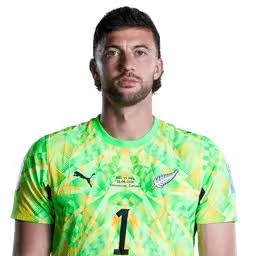
Egil Selvik (#1): The Norwegian goalkeeper arrived from Watford on a loan with an obligation to purchase, thrust into the starting role following Grégoire Coudert’s departure to Burnley. The 29-year-old, who stands 1.93m, faced a baptism of fire after arriving just a week before the season opener, but has adapted quickly and kept four clean sheets in his first four appearances.
Noé Poillion (#16): The young goalkeeper arrived on loan from FC Metz to provide backup coverage, his development representing part of Brest’s strategy of recruiting young French talent.
Romain Cagnon (#49): The free-transfer arrival provides additional depth between the posts.
Defenders
Brendan Chardonnet (#5): The captain returned to full fitness after missing the opening weeks with a calf injury, his leadership and defensive organisation central to Lachuer’s structure. His experience of Brest’s Champions League campaign provides invaluable guidance for a squad in transition.
Raphaël Le Guen (#71): The 20-year-old academy graduate had established himself as an undisputed starter before suffering a fractured fibula in training that will keep him out until 2027. His emergence had attracted interest from Premier League clubs, and his absence represents a significant blow to the defensive unit.
Bradley Locko (#2): The left-back remained at the club despite summer interest, his attacking thrust and defensive reliability making him a key figure in Lachuer’s back line.
Kenny Lala (#70): The veteran right-back provides experience and leadership, his positioning and reading of the game compensating for a lack of raw pace.
Gautier Lloris (#4): The summer arrival from HAC adds depth and physical presence to the central defensive options.
Luck Zogbé (#20): The young defender provides additional cover across the back line.
Justin Bourgault (#18): Returning from a loan spell at Nancy, the young defender offers further defensive depth.
Midfielders
Kamory Doumbia (#23): The Malian international has been Brest’s standout performer in the opening weeks, scoring four goals in four matches to emerge as the squad’s most potent attacking threat. His ability to arrive late in the box and finish with either foot has provided a goal threat from midfield that the squad desperately requires.
Hugo Magnetti (#8): The vice-captain signed a contract extension over the summer, a significant statement of continuity amid the club’s broader restructuring. His tactical discipline and work rate make him a trusted option in Lachuer’s structure.
Joris Chotard (#13): The midfielder remained at the club despite summer interest, his passing range and composure offering a creative dimension from deep positions.
Mamady Diambou (#6): The summer arrival from Salzburg brings physical presence and defensive coverage to the midfield.
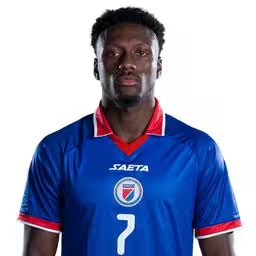
Joseph Nonge (#7): The Belgian midfielder arrived from Kocaelispor, his technical quality and tactical intelligence offering a different dimension in the engine room.
Lucas Tousart (#29): The experienced midfielder has been deployed in central defence during Chardonnet’s absence, his versatility making him a valuable squad option.
Samba Diop (#24): The young midfielder provides additional depth.
Forwards
Ludovic Ajorque (#19): The 32-year-old remains Brest’s primary attacking focal point and the club’s highest earner at €110,000 per month. His physical presence and hold-up play provide a reference point for the attack, though he has managed just one goal in the opening four matches.
Pathé Mboup (#9): The Senegalese forward offers pace and directness, his 12 shots in four matches demonstrating his willingness to test opposition goalkeepers.
Mama Baldé (#17): The forward remained at the club despite interest from Houston Dynamo, his work rate and movement offering a different profile to Ajorque.
Noah Edjouma (#11): The deadline-day loan arrival from LOSC adds pace and creativity on the right flank, filling the void left by Del Castillo’s departure. The 20-year-old arrives seeking regular minutes after limited opportunities under Davide Ancelotti.
Djylian N’Guessan (#39): The 18-year-old arrived on loan from Liverpool following his transfer from Saint-Étienne, his potential offering a glimpse of the club’s commitment to post-formation development.
Giovani Versini (#10): The summer arrival from Pau provides additional attacking depth.
Ibrahim Kanté (#21): The young forward offers further competition in the attacking line.
Leadership Group & Squad Regulations
Club Captain: Brendan Chardonnet
The centre-back remains the squad’s designated leader, his experience of Brest’s rise from Ligue 2 to the Champions League providing a reference point for the club’s expectations. His return to fitness after a calf injury is a significant boost for a defensive unit that has already lost Le Guen to a long-term injury.
The Leadership Committee
Hugo Magnetti serves as vice-captain, his contract extension reflecting his importance to the club’s continuity strategy. Ludovic Ajorque provides a senior voice in the attacking line.
Homegrown Quota Check
With Raphaël Le Guen and several other academy graduates in the first-team squad, Brest maintains a connection to their youth pipeline. Lachuer has reiterated the club’s commitment to developing young players, describing it as a “strategic axis”.
Financial & Contractual Health
Financial Balance Overview
Brest’s financial strategy has been defined by caution. Despite receiving €50 million from their Champions League campaign, the club opted to trim their wage bill amid falling domestic television revenue. The average monthly salary has fallen from €60,000 to €50,000, with only Ludovic Ajorque earning more than €100,000 per month. Sporting director Grégory Lorenzi, before his departure, noted that the club ended the year in profit after being in the red before the final accounts, with €30 million of sales contributing.
Contract Red Alerts
Lachuer’s contract runs until 2028, providing stability in the dugout. However, many players’ contracts expire in June 2027, including key figures such as Chardonnet, Magnetti, and Doumbia. The club’s ability to retain these players will depend on their willingness to accept salaries within the new structure.
The Academy Pipeline & Loan Tracker
Breakout Talents to Watch
Raphaël Le Guen had been the great success story of Brest’s youth investment, establishing himself as an undisputed starter before his injury setback. The 20-year-old signed his first professional contract in January 2026 and had attracted interest from Premier League clubs before the club resisted approaches. His recovery will be closely monitored as he targets a return in 2027.
Notable Out on Loan
Hamidou Makalou has been loaned to SC Bastia to gain regular minutes, while Axel Camblan departed permanently to Estoril.
Set-Piece Specialists & FPL Cheat Sheet
Penalties: Kamory Doumbia (First Choice) / Ludovic Ajorque (Second Choice).
Direct Free-Kicks: Joris Chotard / Hugo Magnetti.
Corners & Crosses: Joris Chotard / Hugo Magnetti.
Final Outlook: A New Story Begins
Brest enters 2026/27 in a state of managed transition. The death of Eric Roy, the architect of the club’s greatest era, cast a shadow over the summer that no transfer activity could dispel. The departures of Lorenzi and several high-earning players have left a squad rebuilt on prudence, with Lachuer tasked with preserving Ligue 1 status while writing a new chapter in the club’s history.
The early-season returns offer cautious encouragement. Brest sit ninth in Ligue 1 after four matches, with six points from a challenging opening schedule that included a narrow defeat to Paris Saint-Germain. Doumbia’s goalscoring form has been a revelation, and the defensive structure inherited from the Roy era remains intact. The return of Chardonnet provides leadership at the back, though Le Guen’s injury is a significant setback.
The challenge ahead is survival. Brest’s wage restructuring has created financial stability, but the squad lacks proven attacking depth beyond Ajorque and Doumbia. The loan arrivals of Edjouma and N’Guessan offer potential but not guaranteed output. Lachuer’s ability to foster a collective spirit — the quality he identified as having eroded last season — will determine whether Brest can navigate the season without being dragged into a relegation battle.
The margin for error is moderate. Brest’s recent history demonstrates that the club is capable of exceeding expectations, and the defensive foundation remains sound. But the emotional weight of Roy’s absence and the loss of key personnel mean that Lachuer faces a uniquely difficult task. If he can stabilise the squad and extract the best from a group rebuilt on modest resources, Brest possesses the foundation to achieve survival. If not, the club may discover that the post-Champions League era is considerably more challenging than the heights that preceded it.