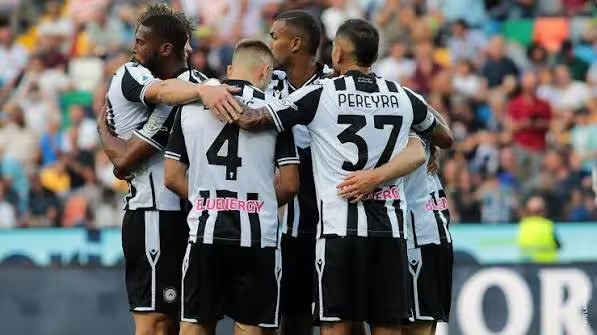
CLUB SNAPSHOT: At a Glance
| Category | Details |
|---|---|
| Club | Udinese Calcio |
| League | Serie A |
| Manager | Paolo Zanetti (appointed November 2026) |
| Stadium | Bluenergy Stadium |
| Nickname | I Bianconeri / Friulani |
| Founded | 1896 |
| Defensive Leader | Oumar Solet |
| Marquee Arrival | David Alaba (free transfer) |
| Key Departure | Thomas Kristensen (loan to Atalanta) |
| Defining Trait | A defence in crisis, conceding 2.30 goals per game |
The Defining Moment
Udinese’s defensive season was defined by a collapse that cost Kosta Runjaic his job. The German coach had set a target of conceding no more than one goal per game. By the tenth round, his team had shipped 23 goals—more than double the intended threshold. The 5-2 home defeat to Roma, a match already 3-0 down at half-time, was the final straw. Runjaic was dismissed, and Paolo Zanetti was appointed with a contract until June 2027 and an automatic renewal option if he secures survival.
The defining problem Zanetti inherited was structural. Udinese’s defensive metrics were alarming across every measure: 2.30 goals conceded per match, 1.95 expected goals against per match, and just 22% clean sheets—rankings of 17th, 19th, and 13th respectively in Serie A. The back line that Runjaic had assembled was fragile in every phase: patient build-up, crosses from wide areas, set-pieces, and sudden through balls all exposed the same cracks.
The defining figure amid the chaos was Oumar Solet. The French centre-back remained the one undisputed pillar, a player whose fitness determined the entire structure of the back three. Around him, the personnel shuffled constantly: David Alaba’s muscle injury, Christian Kabasele’s suspension, Matteo Palma’s unavailability, and the departures of Thomas Kristensen and Saba Goglichidze left Zanetti with a rotation in perpetual flux.
This is the story of Udinese’s 2026/27 defenders: a French anchor holding together a collapsing structure, an Austrian legend brought in to provide experience and quality, and a supporting cast of young players and veterans whose collective fragility defined the season’s first act.
Tactical Context
Zanetti’s preferred system is the 3-5-2, a shape he believes is “a fundamental requirement” for the Udinese dugout. The three-man defence is designed to provide compactness and cover for wing-backs who are encouraged to advance high. The central trio is expected to defend aggressively, step into midfield to break lines, and distribute accurately to the wide players.
The early-season numbers under Runjaic revealed a structure that was anything but compact. Udinese faced 14.5 shots per match, with 4.9 on target—figures that placed them among the division’s most besieged defences. The expected goals against of 1.95 per match suggested that the problems were systemic rather than merely the result of individual errors. The goals prevented metric of -0.05 indicated that the goalkeepers were, if anything, performing slightly below expectation rather than bailing out a failing defence.
Zanetti’s immediate priority was to “recover key figures both physically and mentally,” with Solet, Zaniolo, and Davis identified as the players whose form would determine whether the shadows lifted. The new coach’s approach emphasises intensity and verticality, with a defensive phase built on “compattezza, linee corte e baricentro aggressivo”—compactness, short lines, and an aggressive centre of gravity. Whether the current personnel can execute that vision remains the defining question of Udinese’s season.
The Defenders
Oumar Solet
Solet is the defensive anchor and the one player whose presence transforms Udinese’s back line from fragile to functional. The French centre-back, born in 2000, has been at the club since 2024, and his physical profile—tall, quick, and comfortable in possession—makes him indispensable to any three-man structure.
His season has been disrupted by fitness concerns, with the club managing his return carefully before the international break to ensure he was at peak condition for the resumption. When fit, Solet is the first name on the team sheet regardless of whether he operates as the central defender or the right-sided braccetto. His ability to cover ground and defend in wide areas compensates for the limitations of his partners.
At 26, Solet is in his prime. The interest from larger clubs that has followed him since his Lyon days has not materialised into a transfer, and Udinese’s survival hopes rest on him remaining fit and available for the remainder of the campaign.
David Alaba
Alaba is the marquee arrival, a free transfer from Real Madrid whose pedigree—multiple Champions League titles, domestic championships across three countries—represented a statement of intent from a club of Udinese’s resources. The Austrian’s versatility allows him to operate as the central defender or the left-sided braccetto, his left foot providing balance and quality in build-up.
His season, however, has been defined by fitness. A muscle strain in his right calf ruled him out for a period, with a return projected after the November international break. When available, Alaba offers experience and composure that the younger defenders around him lack. His presence in the back three was intended to provide the leadership that Runjaic’s structure required.
At 34, Alaba’s best years are behind him, but his quality remains undeniable. Whether he can stay fit long enough to justify his significant wages is the question that will define his Udinese career.
Christian Kabasele
Kabasele is the veteran presence whose season began with a suspension—a two-match ban carried over from the previous campaign’s finale against Napoli. Upon his return, he offered the physicality and experience that the youthful back line lacked, his 85 minutes against Venezia in the Coppa Italia demonstrating his enduring value.
His profile is that of a traditional, combative centre-back. At 35, Kabasele is no longer the player who impressed in his first season at the club, but his reading of the game and his aerial ability remain assets within a squad that lacks depth in central defence.
James Abankwah
Abankwah is the young defender whose development has been accelerated by circumstance. The 22-year-old Irish-Ghanaian returned from a loan spell at Watford and was immediately thrust into the starting XI as the right-sided braccetto, his athleticism and willingness to engage making him a valuable option within a depleted back line.
His profile is that of a developing, front-foot defender. Abankwah is quick and aggressive, comfortable defending in wide areas, but his positioning and decision-making remain works in progress. At 22, he represents both an immediate solution and a long-term investment.
Matteo Palma
Palma is the young centre-back whose season was disrupted before it began. A muscle problem ruled him out for a month in August, depriving Runjaic of one of his few options in central defence. Upon his return, he was identified as “one of the few positive notes” of Udinese’s recent performances, his composure and ball-playing ability offering a different dimension to the more physical defenders around him.
At 19, Palma is not yet a finished product, but his potential is significant. The club’s decision to extend his contract until 2031 reflected a belief that he can develop into a long-term solution.
Hassane Kamara
Kamara is the first-choice left wing-back, a 32-year-old Ivorian whose energy and experience have made him a reliable presence on the flank. His defensive contributions are as important as his attacking output within a system that demands constant running from its wide defenders.
Mergim Vojvoda
Vojvoda is the right wing-back, a summer arrival from Como who has endured a difficult start to his Udinese career. The Kosovo international’s experience of Champions League football with his previous club offered hope that he could provide the quality that the right flank lacked, but his adaptation to Zanetti’s demands is ongoing.
Alessandro Zanoli
Zanoli is the rotational option at wing-back, a summer signing from Napoli whose season has been disrupted by injury. His two separate absences—muscle fatigue in October and an unknown injury in late October—limited his availability during the crucial early months.
Nicolò Bertola and Alessandro Ebosse
Bertola, a 23-year-old Italian, and Ebosse, a 27-year-old Cameroonian, provide depth across the back line. Bertola’s versatility—he can operate as a braccetto on either side—makes him a valuable squad option, while Ebosse’s physical profile offers a different dimension when fit.
The Numbers Game
TABLE A: Udinese Defender Serie A Statistics (2026/27)
| Player | Role | Context |
|---|---|---|
| Oumar Solet | Centre-Back | Undisputed pillar when fit |
| David Alaba | Centre-Back | Free transfer, injury-hit |
| Christian Kabasele | Centre-Back | Suspension disrupted start |
| James Abankwah | Right Braccetto | Young option, thrust into starting XI |
| Matteo Palma | Centre-Back | Early injury, identified as positive note |
TABLE B: Udinese Defensive Unit – Key Metrics (2026/27)
| Metric | Value | Context |
|---|---|---|
| Goals Conceded per Match | 2.30 | 17th in Serie A |
| xG Against per Match | 1.95 | 19th in Serie A |
| Shots on Target Faced per Match | 4.9 | 19th in Serie A |
| Clean Sheet Percentage | 22% | 13th in Serie A |
TABLE C: Defender Career Context & Pedigree
| Player | Nationality | Previous Clubs | Style Profile |
|---|---|---|---|
| Oumar Solet | France | Lyon, RB Salzburg | Athletic, composed, covers ground |
| David Alaba | Austria | Real Madrid, Bayern Munich | Versatile, left-footed, experienced |
| Christian Kabasele | Belgium | Watford, Genk | Physical, aerial, veteran |
| James Abankwah | Ireland/Ghana | Watford (loan) | Quick, aggressive, developing |
| Matteo Palma | Italy | Udinese Academy | Composed, ball-playing, prospect |
Tactical Identity & Squad Balance
Udinese’s defensive unit reflects a club that gambled on continuity and lost. The decision to sell Thomas Kristensen to Atalanta on loan and allow Saba Goglichidze to depart for Monza left Runjaic with a central defensive pool that was “sovraffollato” in theory but threadbare in practice once injuries and suspensions struck. The arrival of Alaba on a free transfer was intended to provide experience and quality, but his fitness record has prevented him from becoming the stabilising presence that was envisaged.
The early-season evidence reveals a defence in crisis. The numbers are damning across every metric: 2.30 goals conceded per game, 1.95 xG against, and a clean sheet rate of just 22%. Zanetti’s appointment was a recognition that the structure required rebuilding from the ground up, with the new coach’s emphasis on compactness and aggression representing a fundamental departure from Runjaic’s approach.
The vulnerability identified by analysts is the lack of a settled partnership. Solet is the only undisputed starter, and his fitness determines whether the back three functions or fragments. Alaba’s quality is undeniable but his availability is unreliable. Kabasele, Abankwah, and Palma are all capable of contributing, but none has established himself as a consistent partner for Solet.
The Verdict from the Camp
La Gazzetta dello Sport, on the defensive crisis:
“The main dilemma for the new manager to solve concerns an excessively fragile backline. At the start of the season, Runjaic set the target of conceding at most one goal per game; instead, the current tally stands at 23 in just 10 rounds, more than double the targeted threshold. The Friulians have shown worrying cracks across the board: patient build-up play, crosses from wide areas, free-kicks on the edge of the box, corners and sudden through balls.”
SOS Fanta, on the defensive hierarchy:
“In defence, the pillar Solet is not up for discussion: if he is fit, a shirt is always his. Now he is recovered, and no risks will be taken on his management before the break to have him at his best when the championship resumes. Another who will return after the break is Alaba: he too, if fit, certainly plays on the centre-left. And we are at two absolute certainties in defence.”
Calcio News 24, on Zanetti’s appointment:
“The arrival of Zanetti will bring a tactical identity founded on intensity, verticality and immediate re-aggression. In the defensive phase, his formations are distinguished by compactness, short lines and an aggressive centre of gravity, with precise pressing aimed at dirtying opponents’ trajectories.”
Where Next?
Udinese’s defensive priority is clear: Zanetti must find a way to make the back three function with the personnel available, and he must hope that Solet and Alaba remain fit long enough to establish the partnership that Runjaic never found. The numbers from the opening ten matches are those of a relegation-threatened side, and the margin for error in Serie A is unforgiving.
The development of Palma and Abankwah is the most intriguing subplot. If either can establish himself as a reliable partner for Solet, Udinese possess a defensive core capable of serving the club beyond this season. If neither can, the reliance on the aging Alaba and Kabasele becomes even more precarious.
The January window may offer an opportunity to add defensive reinforcements, but Udinese’s financial constraints and the summer’s net positive balance suggest that significant investment is unlikely. Zanetti must work with what he has: a French anchor whose fitness is paramount, an Austrian legend seeking one last challenge, and a supporting cast whose collective fragility has defined the season’s first act.
For now, Udinese’s defenders are a unit built on hope and contingency: a pillar who cannot be replaced, a veteran whose body cannot be relied upon, and a back line whose individual moments of quality have been overwhelmed by a systemic collapse that cost one coach his job and now defines his successor’s task.