Udinese entered the 2026/27 season with a clear mandate: build on last season’s highest Serie A finish in thirteen years and push for European contention. Kosta Runjaić’s third campaign in charge has been defined by continuity, a summer of measured investment, and a mid-season gamble on a decorated free agent. Four matches in, sitting thirteenth on four points with eight goals scored and ten conceded, the Bianconeri remain a work in progress — a squad with attacking potency but defensive vulnerabilities that the arrival of David Alaba is intended to address.
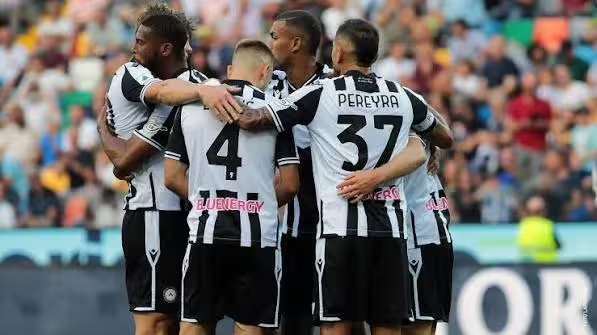
Technical Leadership & Coaching Profile
Manager: Kosta Runjaić
Runjaić signed a contract extension in July 2025, committing him to the club until June 2027, with reports indicating the ownership’s intention to extend further to 2028. The German coach’s second season delivered Udinese’s best league placement since 2012/13, earning him the Serie A Coach of the Month award for May 2026.
His position was strengthened by reported interest from Lazio and German clubs, which he declined in favour of continuing the project in Friuli. The club’s technical leadership has been equally stable: Gökhan Inler signed a two-year extension as Head of Technical Area through June 2028, with General Manager Franco Collavino describing the renewal as “an important stone for our technical planning”.
Owner Gianpaolo Pozzo, celebrating his 85th birthday, used the announcement to reaffirm his commitment: “There has never been any talk of selling the club. We want to continue to grow and return to Europe.” He cited the Atalanta model as inspiration for potential new investment, while insisting the sporting project would proceed with the same coach.
Tactical Philosophy
Runjaić has established a 3-4-2-1 system as Udinese’s base formation, a structure that prioritises defensive solidity through the back three while enabling rapid transitions through the two attacking midfielders behind a lone striker.
The approach is pragmatic and reactive. In the pre-season victory over Barcelona, Udinese demonstrated the template: conceding possession to technically superior opponents, maintaining defensive compactness, and striking on the counter. This was evident again in the 5-3 defeat at Inter, where Udinese scored three goals despite holding just 34% possession.
The system’s success depends on the wing-backs providing width and the attacking midfielders (typically Zaniolo and one other) connecting midfield to attack. Defensively, the back three has struggled for consistency, conceding 11 goals in the first five matches — a statistic that prompted the club’s late move for Alaba.
Preferred Formations
3-4-2-1 (primary) / 3-4-3 (when utilising wide forwards)
Strategic Transfer Activity
Udinese’s summer window was characterised by continuity over upheaval. The only major departure was Arthur Atta, sold to Fiorentina, with the club reinvesting selectively rather than overhauling a squad that had just delivered its best season in over a decade.
The arrivals reflect Udinese’s dual strategy under Inler: developing young assets with resale value while adding experienced players to support immediate performance. Mergim Vojvoda arrived from Como to strengthen the wing-back positions, while Unai Gómez brought Basque technical quality to the attacking midfield role. The return of Matteo Palma from his Sampdoria loan was treated as a new signing, with the defender expected to compete for a starting role.
The most significant addition came after the window closed. With Udinese having conceded 11 goals in five matches, Technical Director Gian Luca Nani moved to sign David Alaba on a free transfer following the Austrian’s departure from Real Madrid. The 34-year-old signed until June 2027, bringing four Champions League titles and over a decade of elite experience to a defence that has lacked a commanding presence.
Table A: Summer Major Transfer Influx
| Player | Position | Former Club | Fee Paid |
|---|---|---|---|
| David Alaba | Centre-Back | Free agent | Free |
| Mergim Vojvoda | Wing-Back | Como | Undisclosed |
| Unai Gómez | Attacking Midfielder | Athletic Club | Undisclosed |
| Matteo Palma | Centre-Back | Sampdoria (loan return) | — |
| Nicolò Zaniolo | Attacking Midfielder | Galatasaray (loan made permanent) | Undisclosed |
The First-Team Roster
Goalkeepers
Maduka Okoye (#40): The Nigerian international remains Udinese’s first-choice goalkeeper when fit, his athleticism and shot-stopping having established him as one of Serie A’s more reliable custodians. An injury disrupted his pre-season, but his return is central to Runjaić’s defensive plans.
Edoardo Piana (#93): The young goalkeeper impressed during pre-season, including a standout performance against Swansea where he made several important saves. His development provides Udinese with a capable understudy and long-term option.
Daniele Padelli (#1): The veteran goalkeeper offers experience and professionalism within the squad, though his on-field role is primarily as emergency cover.
Defenders
David Alaba (#22): The marquee signing of the season. Alaba arrives with a CV that includes four Champions League titles, ten Bundesliga crowns, and two La Liga championships. His versatility allows him to play as the central defender in Runjaić’s back three or as the left-sided centre-back, where he is expected to compete with Enzo Ebosse. The primary concern is his recent injury record: he made just 16 appearances for Real Madrid last season, and his physical continuity will determine whether this proves a masterstroke or a nostalgia signing.
Oumar Solet (#28): The French centre-back has been a commanding presence when available, his physicality and recovery pace suited to the demands of a back three. An injury sustained before the international break is expected to resolve in time for the Torino fixture.
James Abankwah (#2): The Irish defender returned from a productive loan at Watford and has established himself as a first-team regular. Inler cited Abankwah as the model for the Udinese-Watford development pathway: “He played many games with Watford, and this season he came back and is more ready”.
Christian Kabasele (#27): The experienced Belgian centre-back provides leadership and aerial dominance within the defensive group. His role may reduce with Alaba’s arrival, but his professionalism and Serie A know-how remain valuable across a long season.
Enzo Ebosse (#3): The Cameroonian defender has featured regularly in the back three, typically on the left side. Alaba’s arrival places his starting position under direct threat, though squad rotation will ensure opportunities.
Matteo Palma (#5): The young centre-back returned from his Sampdoria loan ready to compete for a role. His development is a priority for the club’s technical staff.
Mergim Vojvoda (#19): The Kosovan wing-back arrived from Como to strengthen the right flank, bringing Serie A experience and attacking thrust.
Hassane Kamara (#12): The Ivorian wing-back offers pace and directness on the left, his overlapping runs a key outlet in the 3-4-2-1 system.
Jordan Zemura (#33): The Zimbabwean wing-back provides competition and depth on the left flank, his energy suited to Runjaić’s demands for width.
Midfielders
Jesper Karlström (#8): The Swedish midfielder is the captain and the tactical anchor of Runjaić’s system. His positioning, ball-winning, and ability to recycle possession provide the platform for Udinese’s transitions. He was the only Udinese player at the 2026 World Cup, representing Sweden.
Sandi Lovrić (#4): The Slovenian midfielder offers technical quality and set-piece delivery, his passing range an important creative outlet from deeper positions.
Oier Zarraga (#6): The Spanish midfielder provides energy and tactical discipline in the double pivot, his work rate essential to the pressing structure.
Jurgen Ekkelenkamp (#10): The Dutch midfielder arrived with a reputation for late runs into the box and goals from midfield. His integration into the attacking midfield rotation offers Runjaić a different profile behind the striker.
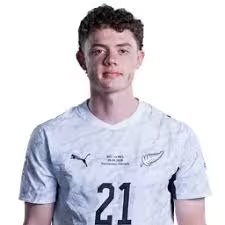
Lennon Miller (#21): The Scottish midfielder is one of Udinese’s most highly-rated young assets, a product of the club’s recruitment pipeline for emerging talent. His development under Runjaić and Inler is closely monitored.
Unai Gómez (#14): The Basque attacking midfielder arrived to add creativity between the lines. His technical quality and vision make him a candidate for the two attacking midfield positions behind the striker.
Rui Modesto (#77): The Portuguese midfielder provides additional depth across central and wide positions.
Forwards
Nicolò Zaniolo (#7): The Italian international is Udinese’s most important attacking player and the focal point of their offensive structure. His contract stand-off in July — which saw him abandon pre-season training for over a week — was resolved with a new deal through 2029 worth a reported €1.8m–€2m per season, restructured to separate fixed salary from performance bonuses. Galatasaray retains a 50% sell-on clause, adding complexity to any future transfer. Zaniolo’s power, dribbling, and goal threat from the attacking midfield positions are irreplaceable within the squad.
Keinan Davis (#9): The English striker has established himself as Udinese’s primary centre-forward, reaching double figures last season. His physical presence and hold-up play are essential to the 3-4-2-1 system, providing the focal point for Zaniolo and the attacking midfielders to play off.
Vakoun Bayo (#11): The Ivorian striker demonstrated his value with the winning goal against Barcelona in pre-season, showcasing his movement and finishing instinct. He provides a genuine alternative to Davis, with a different profile based on pace in behind rather than hold-up play.
Idrissa Gueye (#17): The young Senegalese forward represents Udinese’s investment in developmental attacking talent. His athleticism and potential have attracted interest from larger clubs, and his progression is a key part of the club’s long-term strategy.
Iker Bravo (#29): The Spanish forward offers additional depth in the attacking positions, his movement and technical ability suited to the supporting roles behind the striker.
Leadership Group & Squad Regulations
Club Captain: Jesper Karlström
The Swedish midfielder has established himself as Udinese’s on-field leader, his tactical discipline and consistency making him the natural choice to wear the armband. His experience of the club’s methods across multiple seasons provides continuity within a squad that has evolved gradually rather than through wholesale change.
The Leadership Committee
Christian Kabasele and Sandi Lovrić serve as senior voices alongside Karlström, their combined Serie A experience providing guidance to a squad that contains several young players adapting to top-flight football. David Alaba’s arrival adds an authoritative presence whose leadership credentials — forged at Bayern Munich and Real Madrid — may prove as valuable as his on-field contributions.
Homegrown Quota Check
With Giulio Vinciati — a Friulian-born forward who captained the Primavera and signed his first professional contract until 2029 — Udinese maintains its connection to local talent. The club’s broader development model relies less on homegrown quotas than on the multi-club pipeline with Watford, which allows young players to gain competitive experience before returning to Serie A. Inler described this as “a good combination for the players,” citing Abankwah as the successful template.
Financial & Contractual Health
Financial Balance Overview
Udinese’s financial model under the Pozzo family has always prioritised sustainability and player development over speculative spending. The club’s ability to operate within Serie A’s economic constraints while maintaining a competitive squad is a testament to the multi-club structure, which reduces risk by providing development pathways for players who might not be immediately ready for Italian football.
Owner Gianpaolo Pozzo has rejected the notion of selling the club, instead expressing openness to new investors who could increase competitiveness — citing Atalanta’s model of gradual growth as the preferred path.
Contract Red Alerts
Nicolò Zaniolo’s situation remains the most significant contractual complexity. His new deal through 2029 resolved the immediate stand-off, but Galatasaray’s 50% sell-on clause means any future transfer would see Udinese surrender half the fee. This effectively makes Zaniolo’s retention more financially logical than a sale, unless an exceptional offer materialises.
Kosta Runjaić’s contract expires in June 2027, though reports indicate the club intends to extend it to 2028. Securing the coach’s future would reinforce the continuity strategy that has defined the Pozzo era.
The Academy Pipeline & Loan Tracker
Breakout Talents to Watch
Giulio Vinciati is the most prominent academy product on the verge of first-team involvement. The 2007-born forward captained the Primavera, finished as the team’s top scorer in Primavera 2, and has already collected three Serie A bench appearances. His first professional contract, signed in May 2026, runs until 2029.
Lennon Miller represents the recruitment side of Udinese’s development model: a young Scottish midfielder identified for his potential and integrated gradually into the first-team environment.
Idrissa Gueye continues to attract external interest, and his progression will be closely monitored as a barometer of the club’s developmental success.
Notable Out on Loan
Udinese’s loan strategy is inextricably linked to the Watford partnership. Players who require competitive minutes that cannot be guaranteed in Serie A are directed to the Championship, where the physical and tactical demands provide an appropriate stepping stone. Abankwah’s successful loan spell and subsequent return to the first-team squad is the model case.
Set-Piece Specialists & FPL Cheat Sheet
Penalties: Nicolò Zaniolo (First Choice) / Keinan Davis (Second Choice).
Direct Free-Kicks: Sandi Lovrić / Unai Gómez.
Corners & Crosses: Sandi Lovrić / Mergim Vojvoda / Hassane Kamara.
Final Outlook: Continuity Tested by Defensive Crisis
Udinese’s 2026/27 season has begun with the familiar tension between ambition and pragmatism. Four matches have produced four points, eight goals scored and ten conceded — a record that reflects both the attacking threat at Runjaić’s disposal and the defensive fragility that prompted the late move for Alaba.
The squad possesses genuine quality in the attacking third. Zaniolo’s contract resolution removed a significant distraction, and his partnership with Davis and Bayo provides multiple routes to goal. The 5-3 defeat at Inter, while a loss, demonstrated Udinese’s capacity to score against elite opposition. Karlström’s leadership and Lovrić’s technical quality give the midfield a solid foundation.
The defensive concerns are real. Conceding eleven goals in five matches is not sustainable for a side with European aspirations, and Alaba’s arrival is a calculated gamble. If the Austrian can remain fit, his experience and defensive intelligence could transform the back three. If injuries intervene — as they have repeatedly in recent seasons — Udinese will rely on the existing options to find consistency.
The fixture list offers no respite. A trip to Torino after the international break, followed by Cagliari at home, presents opportunities to stabilise before the schedule intensifies. Runjaić’s track record of incremental improvement, and Inler’s patient development model, suggest the club will not panic. But the margin between a push for Europe and a mid-table scrap is narrow, and Udinese’s season will be defined by whether the defence can match the ambition of the attack.