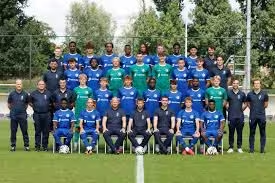
CLUB SNAPSHOT: At a Glance
| Category | Details |
|---|---|
| Club | SV 07 Elversberg |
| League | Bundesliga |
| Manager | Vincent Wagner |
| Stadium | Ursapharm-Arena an der Kaiserlinde |
| Nickname | Die Elv |
| Founded | 1907 |
| Leading Scorer (Forwards) | David Mokwa (2 goals) |
| Supporting Options | Lukas Petkov, Cole Campbell, Noel Futkeu |
| Current League Position | 7th (13 points from 8 matches) |
The Defining Moment
Elversberg’s forward line entered 2026/27 as the great unknown of the club’s first Bundesliga campaign. While the midfield was stocked with loanees from Barcelona, Bayern, and Leverkusen, and the defence retained the core that had secured promotion, the attack was a patchwork of permanent signings and academy graduates. No player in the forward department had ever played Bundesliga football. The club’s record signing, Cole Campbell, was a 20-year-old American from Borussia Dortmund’s academy. The leading candidate to start up front, David Mokwa, had spent the previous season in the 2. Bundesliga.
The defining moment of the season came not with a marquee arrival, but with a collective realisation: Elversberg did not need a prolific striker to survive. They needed goals from everywhere. By the end of October, Vincent Wagner’s side had scored 16 goals in eight matches — a return of 2.00 per game that placed them among the division’s more productive sides. The goals were spread across the squad: Krattenmacher, a midfielder, led the scoring with three; Petkov, a wide forward, had two; Mokwa had two; and defenders like Rohr and Günther had contributed one each.
David Mokwa has been the closest thing to a focal point. The 22-year-old Frenchman, signed permanently after a loan spell, has started seven of Elversberg’s eight league matches, scoring twice and providing one assist. His profile is that of the modern, mobile forward: capable of running the channels, pressing defenders, and arriving in the box late. He is not a target man, nor a prolific finisher, but he embodies the collective, fluid attacking approach that Wagner’s system demands.
This is the story of Elversberg’s 2026/27 forwards: a French workhorse exceeding modest expectations, a Bulgarian winger providing the goalscoring threat from wide areas, a record signing finding his feet, and a supporting cast of loanees and veterans making one of Germany’s smallest clubs one of its most unpredictable.
Tactical Context
Wagner’s attacking structure is built on fluidity and positional rotation. The 4-2-3-1 that appears on the team sheet is a starting point, not a fixed identity. During build-up, the forwards interchange positions constantly, dragging defenders out of shape and creating space for the advancing midfielders. The central striker is not a static target man; he is a mover, a presser, a player who contributes to the collective defensive effort as much as the attacking one.
The numbers reflect a forward line that is functioning despite the absence of a proven Bundesliga goalscorer. Elversberg have scored 16 goals in eight matches, with no single player reaching double figures or even close to it. The distribution has been remarkably even: Krattenmacher (3), Petkov (2), Mokwa (2), Keidel (2), and six other players with one each. It is a system that creates chances for a variety of players rather than depending on a single source.
The tactical challenge is the absence of a genuine alternative to Mokwa. The supporting cast — Petkov, Campbell, Futkeu — are wide forwards or second strikers rather than natural centre-forwards. When Mokwa has been substituted or rotated, Wagner has often deployed a midfielder or a winger through the middle, a testament to the squad’s thinness in the central attacking position. The January window may offer an opportunity to add another forward, but Elversberg’s resources are limited and the club’s model prioritises development over immediate reinforcement.
The Forwards
David Mokwa
Mokwa is the closest thing to a first-choice striker in Elversberg’s squad. The 22-year-old Frenchman, who arrived initially on loan before making the move permanent, has started seven of the club’s eight league matches, scoring twice and providing one assist. His profile is that of the modern pressing forward: mobile, hard-working, capable of running the channels and arriving in the box late.
His numbers reflect a player performing admirably in a system that does not rely on a single goalscorer. Two goals in 598 minutes is a modest return, but his contribution extends beyond those numbers. He presses relentlessly, occupies defenders, and creates space for the attacking midfielders to exploit. His average rating of 6.78 places him in the middle of the squad, neither outstanding nor inadequate.
At 22, Mokwa is still developing. He is not a long-term solution, but he is precisely the kind of hard-working, tactically intelligent forward that a newly promoted side needs. If he can add a clinical edge to his work rate, he may attract interest from bigger clubs. If he cannot, Elversberg will need to find goals from elsewhere.
Lukas Petkov
Petkov is the most productive forward in the squad, a 26-year-old Bulgarian who has scored two goals and provided two assists in ten appearances. His profile is that of the direct, pacey wide forward: capable of beating his man, delivering crosses, and arriving in the box to score. He has started every league match, completing 889 minutes — the most of any outfield player.
His numbers reflect a player who has seized his opportunity in the top flight. Two goals and two assists in ten appearances is a respectable return for a player adapting to the Bundesliga, and his ability to contribute from wide areas has eased the burden on the central forwards. At 26, Petkov is in his prime, and his continued productivity will be essential to Elversberg’s survival.
Cole Campbell
Campbell is the record signing, a 20-year-old American who arrived from Borussia Dortmund’s academy for a fee in the region of €6 million. His profile is that of the explosive, direct wide forward: fast, technical, capable of beating his man and arriving in the box to score. He has made six appearances, scoring once, his 279 minutes reflecting a rotational role.
At 20, Campbell is a project. His talent is evident, but the adaptation from academy football to the Bundesliga’s intensity has been gradual. The pressure of the record fee has not helped, but his goal against Augsburg in October demonstrated the quality that persuaded Elversberg to invest. If he can establish himself as a regular starter, Elversberg’s attack will become significantly more potent.
Noel Futkeu
Futkeu is the loan signing from Eintracht Frankfurt, a 23-year-old who has made six appearances without scoring. His profile is that of the hard-working, physical forward: capable of holding the ball up and pressing defenders, but lacking the clinical edge that the Bundesliga demands. At 23, he has time to develop, but Elversberg need immediate returns.
Luca Schnellbacher and the Supporting Cast
Schnellbacher, the 31-year-old veteran, has made two appearances, his minutes limited by the emergence of younger options. He provides experience and leadership in a dressing room that includes several young forwards. Raif Adam, the 20-year-old academy graduate, and Filimon Gerezgiher, the 25-year-old, provide depth without yet challenging for regular minutes.
The Numbers Game
Table A: SV Elversberg Forward Bundesliga Statistics (2026/27)
| Player | Apps (Starts) | Minutes | Goals | Assists | Notes |
|---|---|---|---|---|---|
| David Mokwa | 10 (7) | 598 | 2 | 1 | Focal point; pressing forward |
| Lukas Petkov | 10 (10) | 889 | 2 | 2 | Most minutes; wide threat |
| Cole Campbell | 6 (—) | 279 | 1 | 0 | Record signing; adapting |
| Noel Futkeu | 6 (—) | — | 0 | 0 | Loanee; developing |
Table B: SV Elversberg Forward Unit – Key Metrics (2026/27)
| Metric | Value | Context |
|---|---|---|
| Team Goals per Game | 2.00 | 16 goals in 8 matches |
| Mokwa Goals per 90 | 0.30 | 2 goals in 598 minutes |
| Petkov Goal Contribution | 4 | 2 goals, 2 assists |
| Record | 4W-1D-3L | 7th in Bundesliga |
| Campbell Transfer Fee | ~€6m | Record signing |
Table C: Forward Career Context & Pedigree
| Player | Nationality | Previous Clubs | Style Profile |
|---|---|---|---|
| David Mokwa | France | — | Mobile pressing forward, work rate, channel running |
| Lukas Petkov | Bulgaria | — | Direct wide forward, pace, crossing, finishing |
| Cole Campbell | United States | Borussia Dortmund Academy | Explosive winger, technical, developing |
| Noel Futkeu | France | Eintracht Frankfurt (loan) | Physical forward, hold-up play, developing |
Tactical Identity & Squad Balance
Elversberg’s forward line is a study in collective productivity over individual brilliance. The department was assembled with a mixture of permanent signings and loanees, none of whom had proven Bundesliga goalscoring records. The intention was to create a fluid, rotating attack that could compensate for the absence of a prolific striker through shared responsibility.
The numbers tell a story of a system that is working. Sixteen goals in eight matches, spread across ten different scorers, reflects a team that creates chances for a variety of players rather than depending on a single source. Mokwa’s two goals and Petkov’s two goals and two assists have been the most significant contributions, but the supporting cast — Campbell, Keidel, Krattenmacher — have also chipped in.
The depth is the department’s vulnerability. Mokwa is the only natural centre-forward in the squad, and his alternatives are either wide forwards deployed centrally or academy graduates who have not yet proven themselves at this level. The loss of Mokwa to injury or suspension would force Wagner to improvise, and the January window offers little prospect of significant reinforcement given the club’s limited resources.
The most intriguing subplot is the development of Campbell. The record signing has shown flashes of the quality that persuaded Elversberg to invest, but his adaptation to the Bundesliga has been gradual. If he can establish himself as a regular starter and add goals from wide areas, Elversberg’s attack will become significantly more potent. If he cannot, the €6 million investment will loom over a club that cannot afford expensive mistakes.
The Verdict from the Camp
FBref, on Elversberg’s attacking output:
“Goals: 16 (2.00 per game), Goals Against: 16 (2.00 per game), Diff: 0.”
FBref, on David Mokwa:
“David Mokwa: 10 apps, 7 starts, 598 minutes, 2 goals, 1 assist.”
ESPN, on the goalscoring distribution:
“Maurice Krattenmacher: 7 apps, 3 goals. Lukas Petkov: 7 apps, 2 goals. David Mokwa: 7 apps, 2 goals.”
Where Next?
Elversberg’s forward priority is clear: they need Mokwa to stay fit, and they need one of Petkov, Campbell, or Futkeu to provide a genuine second scoring threat from the forward line. The collective approach has worked so far, but the margins are thin. A run of matches without goals from the forwards would place unsustainable pressure on the midfield and defence.
The development of Campbell is the secondary subplot. At 20, he has the potential to become a genuine Bundesliga forward, but the pressure of the record fee and the adaptation to senior football have slowed his progress. If he can find his rhythm in the second half of the season, Elversberg’s attack will become significantly more dangerous.
The January window is unlikely to bring significant forward reinforcements. The club’s resources have been directed toward the loanees and the record signing, and the forward line, for all its limitations, has functioned effectively enough to keep Elversberg in the top half. The priority is to maintain the current structure and hope that injuries do not expose its fragility.
For now, Elversberg’s forwards are a unit defined by collective effort rather than individual brilliance. Mokwa leads the line, Petkov provides the width, Campbell learns, and the supporting cast contributes where it can. The question is whether that collective approach is enough to survive in the Bundesliga. The early-season evidence suggests it might be — as long as the goals keep coming from somewhere, and Mokwa stays on the pitch.