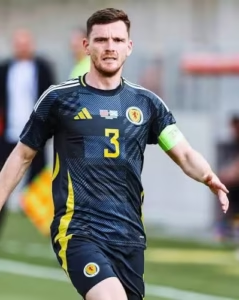
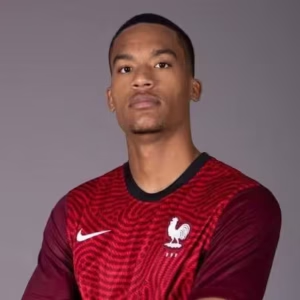
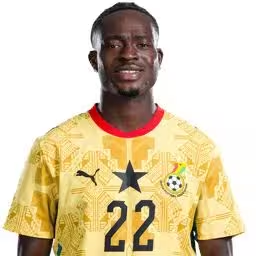
Following a summer of historic transition that saw sporting director Giovanni Carnevali depart for Juventus after thirteen years, Fabio Grosso leave for Fiorentina after guiding the club back to Serie A, and Alberto Aquilani appointed as the new head coach, Sassuolo enters 2026/27 navigating a “zero-cost transfer” mandate imposed by Serie A’s financial control regulations. Despite these constraints, the Neroverdi have assembled a squad of notable depth — eleven signings, with two players for every position, as sporting director Francesco Palmieri emphasized in his summer presentation. Five matches into the campaign, Sassuolo sits 10th in Serie A with 7 points, having scored 9 goals and conceded 9, including a statement 3-2 victory over Juventus.
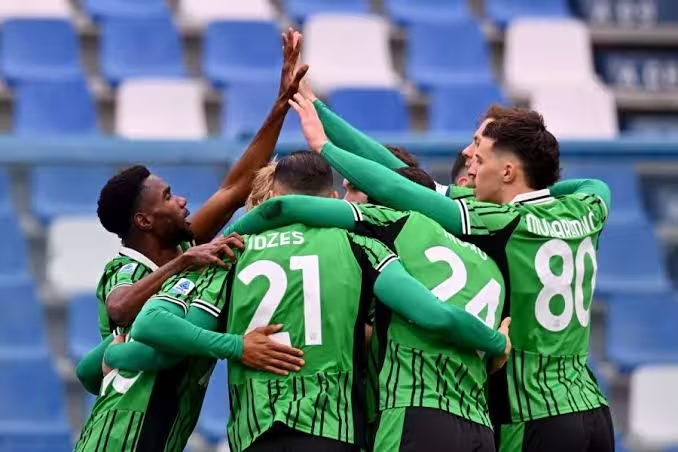
Technical Leadership & Coaching Profile
Manager: Alberto Aquilani
Aquilani was appointed on 12 June 2026, signing a two-year contract with an option for a third season. The former Sassuolo midfielder returns to the club where he spent part of his playing career, taking his first Serie A managerial role after an impressive spell at Catanzaro in Serie B. Aquilani inherits a squad that won promotion under Grosso and retains much of its promoted core, but he must also navigate the departures of key figures in Carnevali and Grosso, as well as the significant sales of Muharemović to Leeds and the looming question of Thorstvedt’s future.
Sporting director Francesco Palmieri, Carnevali’s successor, expressed full confidence in the new coach: “Aquilani is in the right place to fully express his potential. He’s young, but he has great ideas and he’s conveying them to a cohesive and large group”. Palmieri’s assessment reflects a club that has chosen continuity in its project despite the sweeping organizational changes — new sporting director, new CEO in Veronica Squinzi, new coaching staff, but the same ownership and the same commitment to attacking football.
Tactical Philosophy
Aquilani’s Sassuolo continues the club’s tradition of “trazione anteriore” — front-wheel drive, attacking football. The 4-3-3 formation has been the preferred shape through pre-season and the opening matches, with Berardi, Pinamonti (before his departure), and Laurienté forming one of Serie A’s most potent attacking tridents on paper. Nemanja Matić anchors the midfield with his experience, supported by young talents like Luca Lipani and the Juventus loanee Adžić.
Defensively, the loss of Muharemović — sold to Leeds for €27 million net — leaves a significant void, one the club has sought to address through the return of Walukiewicz from Torino and the arrivals of Candé and Idzes. The defense remains a work in progress, as evidenced by the 9 goals conceded in five matches, but the attacking output has been sufficient to keep the Neroverdi competitive.
Preferred Formations
4-3-3
Strategic Transfer Activity
Sassuolo’s summer window unfolded under the same “zero-cost transfer” constraints that restricted Lazio and Monza — the club was required by the independent commission for economic balance to only invest what it generated through sales or salary reductions. This shaped a transfer strategy built on high-value departures funding multiple incoming arrivals.
The headline sale was Tarik Muharemović to Leeds United for approximately €27 million net, with Juventus holding a 50% sell-on clause that effectively reduced the English club’s cost. Andrea Pinamonti’s exit to Lazio followed, structured as a paid loan worth €3 million with an option to buy, a move the striker had actively sought. The club also offloaded several young players on permanent and loan deals, generating additional funds.
The arrivals reflect a mix of experience, youth, and calculated gambles. Kieron Bowie arrived from Hellas Verona in a swap deal involving Mulattieri, providing a young alternative in attack. Vasilije Adžić joined from Juventus on loan, adding creativity to the midfield. Sebastiano Esposito arrived on loan from Cagliari as Pinamonti’s replacement, with Riccardo Ciervo moving in the opposite direction. The defense was reinforced with Jay Idzes, Fali Candé, and the return of Walukiewicz, while Rafa Obrador provided quality cover on the left.
Table A: Summer Major Transfer Influx
| Player | Position | Arrival Type | Former Club |
|---|---|---|---|
| Kieron Bowie | Forward | Permanent (swap) | Hellas Verona |
| Sebastiano Esposito | Forward | Loan | Cagliari |
| Vasilije Adžić | Midfielder | Loan | Juventus |
| Jay Idzes | Center-Back | Permanent | — |
| Fali Candé | Center-Back | Permanent | — |
| Sebastian Walukiewicz | Center-Back | Loan Return | Torino |
| Rafa Obrador | Left-Back | Permanent | — |
The First-Team Roster
Goalkeepers
Arijanet Murić (#49): The Kosovan goalkeeper was signed permanently from Ipswich Town after a successful loan spell, cementing his position as Sassuolo’s first-choice goalkeeper. His shot-stopping and command of the area provide a reliable foundation behind a defense still finding its rhythm.
Stefano Turati (#13): The Italian goalkeeper provides capable backup, with experience at Serie A level.
Giacomo Satalino (#12): Academy graduate providing third-choice depth, though he departed on a free transfer at the end of the season.
Defenders
Jay Idzes (#21): The Indonesian-Dutch center-back is a key figure in Sassuolo’s defensive rebuild. His physical presence and ball-playing ability make him a modern center-back profile suited to Aquilani’s system.
Fali Candé (#5): The Guinea-Bissau international brings athleticism and defensive versatility, capable of operating across the back line.
Cas Odenthal (#26): The Dutch center-back provides additional depth and competition for starting roles.
Sebastian Walukiewicz (#6): The Polish center-back returned from his Torino loan and has been reintegrated as a first-team regular. His Serie A experience is invaluable in a relatively young defensive group.
Josh Doig (#3): The Scottish left-back offers attacking thrust from wide areas, his crossing ability complementing Sassuolo’s attacking wingers.
Edoardo Pieragnolo (#15): Young Italian left-back providing competition and cover.
Rafa Obrador (#33): The Spanish left-back arrived to guarantee “quality options” on the left flank, as Palmieri noted during the summer. His technical quality and attacking instincts fit Aquilani’s system.
Yeferson Paz (#27): Colombian right-back providing depth on the right side of defense.
Duje Ćaleta-Car (#): The Croatian center-back adds international experience and aerial dominance to the defensive rotation.
Midfielders
Nemanja Matić (#18): The Serbian veteran is the midfield’s “sapient hand” — his experience and positional intelligence anchoring the team’s structure. At 38, his leadership and composure in possession remain invaluable for a squad in transition.
Luca Lipani (#35): The young Italian midfielder is one of the academy’s brightest prospects, earning significant first-team minutes alongside Matić. His energy and technical quality mark him as a future cornerstone.
Vasilije Adžić (#17): The Montenegrin loanee from Juventus adds creativity and forward thrust to the midfield line, operating in the attacking third between the lines.
Daniel Boloca (#11): The Italian midfielder provides tactical discipline and work rate in the engine room.
Andrea Ghion (#8): A reliable rotation option with Serie A experience.
Ismaël Koné (#90): The Canadian midfielder suffered a serious injury at the World Cup and remains a long-term absentee. His return will be a significant boost when it comes.
Darryl Bakola (#50): The young French talent was retained despite Juventus interest, a coup for sporting director Palmieri. He represents the club’s commitment to developing high-potential youth.
Kristian Thorstvedt (#42): The Norwegian midfielder’s future remains uncertain, with Fiorentina circling. His dedication to the shirt has been unquestioned, and Palmieri has stated the club will “see what happens” regarding a renewal.
Forwards
Domenico Berardi (#10): The captain and club icon signed a contract extension until 30 June 2029, reaffirming his status as the “absolute offensive reference” of the squad. His leadership, creativity, and goal threat remain central to Sassuolo’s identity.
Armand Laurienté (#45): The French winger is one of Serie A’s most direct attacking threats, his pace and dribbling ability making him a constant outlet on the left. Interest from Besiktas was rebuffed, with the club’s €25 million valuation deterring suitors.
Kieron Bowie (#): The Scottish forward arrived from Hellas Verona as part of the Mulattieri swap, providing a young, athletic option in attack with potential for significant development.
Sebastiano Esposito (#): The Italian forward arrived on loan from Cagliari to fill the void left by Pinamonti’s departure. An Inter academy product with spells at multiple clubs, he offers movement and finishing ability in the box.
Cristian Volpato (#7): The attacking midfielder/winger adds creativity and versatility across the front line.
Agustín Álvarez (#25): The Uruguayan forward provides additional depth in the attacking positions.
Leadership Group & Squad Regulations
Club Captain: Domenico Berardi
Berardi remains the unequivocal leader and symbol of Sassuolo, his contract extension to 2029 ensuring his influence endures through this new era. Aquilani identified Berardi as one of the first players he contacted upon his appointment, recognizing the captain’s importance as a bridge between the old project and the new.
The Leadership Committee
Nemanja Matić provides veteran leadership in the midfield, his experience at the highest level of European football offering guidance to younger players like Lipani and Bakola. Sebastian Walukiewicz, as a returning first-team regular, also carries leadership responsibilities within the defensive unit.
Homegrown Quota Check
Sassuolo’s commitment to internal development remains strong. Luca Lipani represents the academy’s most prominent recent graduate, while Darryl Bakola’s retention despite Juventus interest underscores the club’s determination to protect its youth assets. The Primavera continues to produce talent, with Idriss Coulibaly arriving from Borussia Dortmund’s academy to strengthen the youth pipeline.
Financial & Contractual Health
Financial Balance Overview
Sassuolo’s summer operations were conducted under the “zero-cost transfer” regime, requiring the club to balance incoming investment with outgoing revenue. The €27 million net from Muharemović’s sale to Leeds provided the primary funding source, with Pinamonti’s loan fee and the sales of several young players adding further flexibility. This constrained approach shaped a transfer window built on loans, swaps, and low-cost permanent deals rather than significant cash outlays.
Contract Red Alerts
Thorstvedt’s situation remains the most pressing contractual question. Fiorentina’s interest has not subsided, and while Palmieri has emphasized the Norwegian’s dedication, the club’s financial constraints may make a sale tempting if the price is right. Laurienté’s €25 million valuation has thus far deterred suitors, but sustained interest from wealthy clubs could test Sassuolo’s resolve. The good news is Berardi’s long-term commitment, which provides a foundational piece of stability amid the broader transition.
The Academy Pipeline & Loan Tracker
Breakout Talents to Watch
Luca Lipani is the academy’s flagship prospect, a young midfielder earning regular first-team minutes under Aquilani. His development alongside Matić represents the ideal pathway for Sassuolo’s youth model.
Darryl Bakola was retained despite strong Juventus interest, described as a “talented offensive wide player” by ANSA. His potential is highly rated within the club, and the new season represents his opportunity to break into the first-team rotation.
Idriss Coulibaly arrived from Borussia Dortmund’s academy for the Primavera, a signing that demonstrates Sassuolo’s continued ability to attract high-potential youth from elite European academies.
Notable Out on Loan
Sassuolo’s loan strategy has focused on finding playing time for young talents in lower divisions. Lorenzo Appiah joined Sanremese in Serie D, while several other academy players departed on temporary or permanent deals to further their development. The club’s Primavera remains a priority, with investment continuing despite first-team financial constraints.
Set-Piece Specialists & FPL Cheat Sheet
Penalties: Domenico Berardi (First Choice) / Armand Laurienté (Second Choice).
Direct Free-Kicks: Domenico Berardi / Cristian Volpato.
Corners & Crosses: Domenico Berardi / Josh Doig / Cristian Volpato.
Final Outlook: Navigating the Tactical Horizon
Sassuolo enters 2026/27 in the midst of its most significant organizational revolution in over a decade. The departure of Giovanni Carnevali after thirteen years as the club’s architectural mastermind, the promotion of Fabio Grosso to Fiorentina, and the arrival of Alberto Aquilani represent a clean break from the past — yet one conducted within a framework of continuity. The ownership remains unchanged, the attacking identity endures, and the squad retains its promoted core.
Five matches into the Aquilani era, the returns are encouraging if imperfect. Seven points from a difficult opening fixture list — including a 3-2 victory over Juventus — suggest the new coach has quickly established a competitive baseline. The attacking trident of Berardi, Esposito, and Laurienté has shown flashes of genuine menace, while the midfield axis of Matić and Lipani blends experience with youthful energy. The 9 goals scored in five matches rank among the league’s more productive attacks, even as the 9 conceded highlight the defensive work still required.
The constraints of the “zero-cost” mandate have been navigated with creativity rather than frustration. Palmieri’s “two players per position” squad construction, achieved through eleven signings despite minimal cash expenditure, reflects the sporting director’s calm under financial pressure. The retention of Bakola against Juventus interest, the loan acquisition of Esposito to replace Pinamonti without significant outlay, and the swap deal that brought Bowie from Verona all demonstrate a club adapting intelligently to restrictive conditions.
The unresolved questions are significant. Thorstvedt’s future casts a shadow over the midfield, and a January sale to Fiorentina would deprive Aquilani of a player whose dedication has never been questioned. The defense, having conceded nine goals in five matches, remains a work in progress — the absence of Muharemović’s quality has been felt, and the integration of Idzes, Candé, and Walukiewicz into a coherent unit continues. Koné’s eventual return from his World Cup injury will add a dynamic midfielder to the mix, but his absence has forced Matić into heavier minutes than ideal for a player of his age.
The season’s trajectory will depend on whether Aquilani’s attacking approach can outscore opponents consistently enough to compensate for defensive vulnerabilities. If Berardi remains fit and productive, if Laurienté resists the allure of foreign clubs, and if Esposito adapts quickly to his new surroundings, Sassuolo possesses the firepower to finish comfortably in mid-table. The club’s ambition, as always, extends beyond mere survival — but in a season of transition, stability is the first objective. The Neroverdi’s revolution is underway, and the early signs suggest it is being managed with the same quiet competence that has defined the club’s remarkable rise over the past decade.