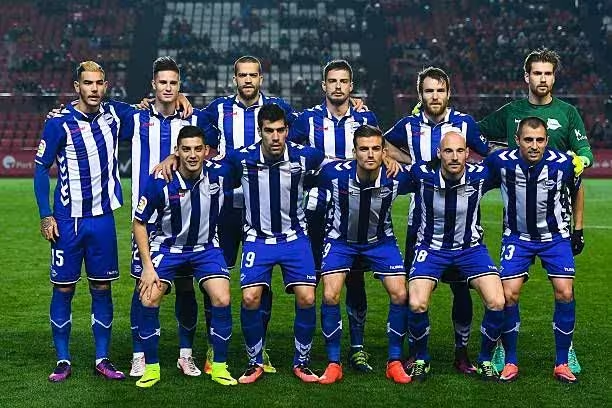
CLUB SNAPSHOT: At a Glance
| Category | Details |
|---|---|
| Club | Deportivo Alavés |
| League | La Liga |
| Manager | Quique Sánchez Flores |
| Stadium | Mendizorroza |
| Nickname | Babazorros |
| Founded | 1921 |
| Defensive Leader | Nahuel Tenaglia |
| Summer Arrivals | Nicolás Valentini, Ville Koski |
| Key Absence | Facundo Garcés (registration delay) |
| Current League Position | 7th (12 points from 10 matches) |
The Defining Moment
Deportivo Alavés’ defensive department entered 2026/27 in a state of tactical transition. Quique Sánchez Flores, who had rescued the club from a turbulent campaign after taking over in March, spent the summer reshaping the team’s identity. The 5-3-2 that had secured survival was to be replaced by a 4-4-2, a system in which the veteran coach felt more comfortable and believed he could “evolve the players.” The defensive implications were significant: three centre-backs became two, the wing-backs became full-backs, and the demands on the remaining defenders intensified.
The defining moment of the summer came not on the training ground, but in the offices of La Liga. Facundo Garcés, the Argentine centre-back signed from Colón, was not registered in time to feature in the opening fixtures. The sporting director, Sergio Fernández, confirmed that Garcés would not be available to compete until “from 1 November, in the match against Barcelona.” It was a bureaucratic delay that left Quique with a thinner defensive corps than he had planned for, forcing him to rely on the players already at the club.
The results have been mixed but broadly positive. Across the opening ten league matches, Alavés conceded 11 goals — 1.10 per game — and kept three clean sheets. The defensive record is mid-table, neither catastrophic nor convincing. But the underlying numbers reveal something more interesting: Alavés have the most interceptions in Europe’s top five leagues this season, with 108. It is a statistic that reflects the aggressive, front-foot defensive approach that Quique has instilled, a system that asks defenders to read the game, step into passing lanes, and disrupt opposition attacks before they develop.
This is the story of Alavés’ 2026/27 defenders: a system in transition, a leader adapting to a new role, and a collection of arrivals and academy graduates fighting for minutes in one of La Liga’s most surprising success stories.
Tactical Context
Quique’s Alavés is a team built on intensity and collective discipline. Nahuel Tenaglia, the Argentine defender who has been at the club since 2022, described the coach’s demands in pre-season: “He asks us to play the ball and to be a team that presses when we don’t have it. He wants us to have a lot of intensity and for everyone to run.” The system that emerged from those demands is a 4-4-2 that shifts between a high press and a compact mid-block, depending on the opponent and the game state.
The defensive numbers reflect a team that is comfortable without the ball but aggressive in its attempts to win it back. The 108 interceptions are the highest in Europe’s top five leagues, a testament to the positioning and anticipation that Quique has drilled into his back line. Alavés do not dominate possession — their 42.9% average is among the lowest in La Liga — but they compensate with organisation and a willingness to engage in duels.
The tactical transition from 5-3-2 to 4-4-2 has placed new demands on the full-backs. In the old system, the wing-backs had cover from three centre-backs. In the new system, the full-backs are more exposed, required to balance attacking ambition with defensive solidity. Tenaglia, a natural centre-back, has been deployed at right-back in the early weeks, a role that asks him to defend wide areas and support the attack without leaving the centre-backs isolated.
The absence of Garcés has compounded the challenge. The Argentine was signed to provide physical presence and aerial dominance in the heart of the defence, but his registration delay has meant that Quique has had to rely on the existing options. Nicolás Valentini, the other summer arrival at centre-back, has been integrated gradually. Ville Koski, signed from NK Istra, has provided depth. The defensive corps is not thin, but it is unbalanced, with too many centre-backs and not enough natural full-backs.
The Defenders
Nahuel Tenaglia
Tenaglia is the leader of Alavés’ defence and the player upon whom Quique’s system depends. The 30-year-old Argentine, standing 180 centimetres, has been at Mendizorroza since 2022 and has established himself as one of the most reliable defenders in the squad. His profile is that of the adaptable defender: comfortable at centre-back or right-back, intelligent in his positioning, and aggressive in his duels.
His role in Quique’s 4-4-2 has been at right-back, a position that asks him to defend wide areas and support the attack without abandoning his defensive responsibilities. In pre-season, he described the adjustment: “We are trying both systems. Today we played with three centre-backs but we are working on both. Quique will decide, but we are prepared to use whichever drawing.” His versatility has been essential in a season of transition.
The numbers from the opening phase reflect his importance. He has been a fixture in the back line, his interceptions and clearances contributing to Alavés’ remarkable defensive statistic. At 30, he is in his prime, and his leadership — both on and off the pitch — is invaluable in a squad that blends experience and youth.
Nicolás Valentini
Valentini is the summer’s marquee defensive signing, a 25-year-old Argentine centre-back who arrived from Fiorentina. Standing 187 centimetres, he offers the physical presence and aerial dominance that Quique wanted in the heart of the defence. His profile is that of the modern South American centre-back: aggressive in the duel, comfortable on the ball, capable of playing either side of the central pairing.
His integration has been gradual. The transition from Italian football to La Liga requires adaptation, and Valentini has been eased into the starting line-up rather than thrown into the deep end. In the early weeks, he has shown the physicality and reading of the game that persuaded Alavés to invest, though his partnership with the other centre-backs is still developing.
At 25, Valentini is entering his prime. If he can establish himself as a fixture in the back four, Alavés will have secured a long-term solution at centre-back.
Facundo Garcés
Garcés is the great what-if of Alavés’ defensive season. The Argentine centre-back, standing 191 centimetres, was signed to provide the aerial dominance and physical presence that the squad lacked. But a registration delay meant he could not feature until November, leaving Quique without one of his key summer arrivals for the opening months of the campaign.
His profile is that of the traditional Argentine centre-back: dominant in the air, committed in the tackle, and capable of playing out from the back. At 27, he arrives at Mendizorroza in his prime, with a point to prove after his spell in Argentine football.
The delay has been frustrating for both player and club, but it has also provided an opportunity. Garcés has had time to adapt to his new surroundings, to train with his teammates, and to learn Quique’s system without the pressure of immediate results. When he finally makes his debut, he will be better prepared than most January arrivals.
Ville Koski
Koski is the other summer defensive arrival, a 24-year-old Finnish centre-back signed from NK Istra. His profile is one of raw potential: tall, athletic, and comfortable on the ball. He has been used sparingly in the opening weeks, with Quique preferring the more established options, but his time will come as the season progresses and rotation becomes necessary.
Jonny Otto
Jonny is the veteran of the defensive unit, a 32-year-old who returned to Alavés after spells at Wolves and PAOK. His profile is that of the experienced full-back: defensively solid, positionally intelligent, and capable of playing on either flank. His minutes have been limited by injury and the emergence of younger options, but his experience is valuable in a dressing room that includes several young defenders.
Adrián Pica and Carlos Ballestero
Pica and Ballestero are the academy graduates who provide depth and competition. Pica, 24, is a tall centre-back who has trained with the first team. Ballestero, 22, is a right-back who has featured in the squad. Neither has established himself as a regular starter, but both represent the pipeline that Alavés’ sporting director, Sergio Fernández, has emphasised: “We have prioritised retaining the greatest possible talent and promoting players formed in the academy.”
The Numbers Game
Table A: Deportivo Alavés Defender La Liga Statistics (2026/27)
| Player | Position | Notes |
|---|---|---|
| Nahuel Tenaglia | Right-Back/Centre-Back | Leader, adaptable, ever-present |
| Nicolás Valentini | Centre-Back | Summer signing, integrating gradually |
| Facundo Garcés | Centre-Back | Registration delay, available from November |
| Ville Koski | Centre-Back | Summer signing, squad depth |
| Jonny Otto | Full-Back | Veteran, injury-limited |
| Adrián Pica | Centre-Back | Academy graduate, depth |
| Carlos Ballestero | Right-Back | Academy graduate, depth |
Table B: Deportivo Alavés Defence – Key Metrics (2026/27)
| Metric | Value | Context |
|---|---|---|
| Goals Conceded per Game | 1.10 | 11 conceded in 10 matches |
| Clean Sheets | 3 | In La Liga |
| Interceptions (Team) | 108 | Most in Europe’s top five leagues |
| Record | 3W-3D-4L | 7th in La Liga |
| Home Record | 3W-1D-2L | 10 points at Mendizorroza |
Table C: Defender Career Context & Pedigree
| Player | Nationality | Previous Clubs | Style Profile |
|---|---|---|---|
| Nahuel Tenaglia | Argentina | Talleres, Atlético Tucumán | Adaptable defender, intelligent positioning, leader |
| Nicolás Valentini | Argentina | Fiorentina, Boca Juniors | Physical, aerial, ball-playing |
| Facundo Garcés | Argentina | Colón | Dominant in air, aggressive, ball-playing |
| Ville Koski | Finland | NK Istra | Tall, athletic, developing |
| Jonny Otto | Spain | Wolves, PAOK | Experienced full-back, defensively solid |
Tactical Identity & Squad Balance
Alavés’ defensive unit is a study in adaptation. The transition from 5-3-2 to 4-4-2 has required players to learn new roles, new responsibilities, and new relationships. Tenaglia’s shift from centre-back to right-back is the most visible example, but the adjustments extend across the back line. The full-backs must now provide width without the safety net of a third centre-back. The centre-backs must defend larger spaces without the cover of an extra body.
The numbers tell a story of efficiency. Eleven goals conceded in ten matches is a record that places Alavés in the middle of La Liga’s defensive cohort, a respectable return for a team that was fighting relegation last season. The three clean sheets reflect a structure that limits the quality of chances opponents create, and a goalkeeper in Sivera who makes the saves he should make.
The most striking statistic is the interceptions. 108 interceptions is the highest in Europe’s top five leagues, a testament to the aggressive, front-foot defensive approach that Quique has instilled. Alavés do not sit back and absorb pressure; they step forward, read the game, and disrupt opposition attacks before they develop. It is a system that requires intelligence and discipline in equal measure, and the players have embraced it.
The depth is adequate but not abundant. With Garcés unavailable until November, Quique has had to rely on Valentini, Koski, and the academy graduates to fill the gaps. The return of Garcés will provide a significant boost, adding physical presence and aerial dominance to a back line that has occasionally been exposed by crosses and set-pieces.
The January window is unlikely to see defensive reinforcements. Alavés’ record is respectable, and the club’s resources are better directed toward the attacking positions that have produced just 14 goals in ten matches. The priority is to integrate Garcés, develop Valentini, and maintain the structure that has produced one of the most surprising defensive records in La Liga.
The Verdict from the Camp
Nahuel Tenaglia, on Quique’s demands:
“He asks us to play the ball and to be a team that presses when we don’t have it. He wants us to have a lot of intensity and for everyone to run. We are trying both systems. Today we played with three centre-backs but we are working on both. Quique will decide, but we are prepared to use whichever drawing.”
Sergio Fernández, on the summer market:
“We have prioritised retaining the greatest possible talent and promoting players formed in the academy. We can say with satisfaction that these objectives have been met. We are grateful to the ownership for supporting and understanding that these assets had to be retained. We are satisfied with the squad we have, which has the arguments to achieve the objectives.”
Sergio Fernández, on Garcés’s registration:
“From 1 November, in the match against Barcelona, he will be able to compete.”
Where Next?
Alavés’ defensive priority is clear: they need Garcés to integrate quickly, and they need the back four to continue adapting to Quique’s 4-4-2. The Argentine’s return in November will provide a significant boost, adding the physical presence and aerial dominance that the defence has lacked. His partnership with Valentini could become the foundation of Alavés’ defensive structure for years to come.
The development of Valentini is the secondary subplot. The Argentine has the talent and the physical attributes to succeed in La Liga, but his adaptation to Spanish football is still ongoing. If he can establish himself alongside Garcés, Alavés will have a centre-back pairing that combines youth, physicality, and ball-playing ability.
The interceptions statistic is the most intriguing tactical subplot. Alavés’ aggressive defensive approach has produced the highest interception count in Europe’s top five leagues, a testament to Quique’s coaching and the players’ execution. If they can maintain that intensity across the season, while reducing the individual errors that have occasionally undermined their record, they could finish in the top half of La Liga for the first time in years.
For now, Alavés’ defenders are a unit defined by adaptation. Tenaglia leads, Valentini develops, Garcés waits, and the academy provides depth. The question is whether adaptation can become cohesion before the season’s decisive moments arrive. The early-season evidence suggests it might be — as long as the structure holds and the interceptions keep coming.