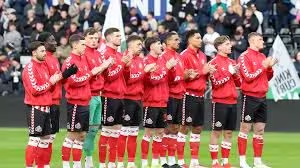
CLUB SNAPSHOT: At a Glance
| Category | Details |
|---|---|
| Club | Bayer 04 Leverkusen |
| League | Bundesliga |
| Manager | Carles Martínez |
| Stadium | BayArena |
| Nickname | Die Werkself |
| Founded | 1904 |
| First-Choice Goalkeeper | Mark Flekken |
| Cup Goalkeeper | Janis Blaswich |
| Third-Choice Option | Niklas Lomb |
| Notable Departure | Lukas Hradecky (contract expired) |
The Defining Moment
Leverkusen’s 2026/27 goalkeeping story is defined by a succession that was planned but not without turbulence. When Lukas Hradecky, the Finnish captain who had been the undisputed No 1 through the club’s Bundesliga triumph and Europa League final run, reached the end of his contract, the club moved decisively. Mark Flekken arrived from Brentford for a fee in excess of €10 million, signed to be the long-term successor. The Dutch international, a former Freiburg goalkeeper with Bundesliga experience and a Netherlands international pedigree, was expected to settle immediately.
The defining moment came not in a save, but in a managerial change that reshaped the hierarchy. Erik ten Hag, the man who had been appointed to replace Xabi Alonso, was dismissed early in the campaign. Carles Martínez, his replacement, inherited a goalkeeping department in flux. Flekken had started the season as the league goalkeeper, but Janis Blaswich—the 35-year-old who had been signed as cover—had impressed in the DFB-Pokal. Martínez was forced to make a choice.
He chose Flekken for the Bundesliga. The numbers have been mixed. Flekken has started seven league matches, conceding 12 goals and saving 14 of 26 shots on target—a save percentage of 53.8%, the lowest of his career at a top-five league club. Leverkusen sit sixth in the table, with a defensive record that is functional rather than formidable. The goalkeeper who was supposed to provide stability has, so far, been part of a unit still finding its feet under a new manager.
This is the story of Leverkusen’s 2026/27 goalkeepers: a Dutch international adjusting to a new league and a new expectation, an experienced German providing cup cover, and a department in transition after the departure of a club legend.
Tactical Context
Martínez’s Leverkusen have operated primarily in a possession-oriented system, with the goalkeeper asked to participate in build-up play and act as an auxiliary defender behind a relatively high line. The approach reflects the modern demands of a top Bundesliga side, but it also places significant pressure on a goalkeeper who is still adapting to his teammates and the tactical demands of his new manager.
The numbers reflect a goalkeeper who has been busy but not always commanding. Flekken has faced 26 shots on target in seven league matches, an average of 3.7 per game, and has saved 14 of them. His 53.8% save percentage is below the standards he set at Freiburg and Brentford, a reflection of both the quality of chances conceded and his own adjustment period. He has kept two clean sheets, a respectable return but not the foundation of a title challenge.
The system also demands composure in possession. Flekken’s distribution has been competent if not exceptional, his long passing offering an outlet against pressing opponents. In a league where goalkeepers are increasingly expected to be playmakers, his adaptation is ongoing.
The structural contrast with last season is stark. In 2025/26, Hradecky provided experience, leadership, and a reassuring presence behind a settled defence. The 2026/27 arrangement is built on a new goalkeeper, a new manager, and a defensive unit that is still being reshaped. The results have been inconsistent. The potential is evident.
The Goalkeepers
Mark Flekken
Flekken is Leverkusen’s first-choice goalkeeper, the Dutch international signed from Brentford to succeed Hradecky. The 33-year-old has started seven Bundesliga matches, conceding 12 goals and keeping two clean sheets.
His profile is that of the modern, physically imposing goalkeeper. At 195 cm, Flekken combines reach with strong reflexes and good control of his penalty area, attributes that sporting director Simon Rolfes highlighted upon his arrival. He is not a sweeper-keeper in the mould of Manuel Neuer, but he is comfortable in possession and capable of contributing to build-up play. His experience at Freiburg and Brentford, where he faced a high volume of shots, prepared him for the demands of a Leverkusen side that aspires to compete on multiple fronts.
The context of his season matters. Flekken arrived in the summer, tasked with replacing a club captain and a goalkeeper who had been central to the most successful period in Leverkusen’s modern history. The weight of that expectation, combined with a managerial change and a defensive unit in transition, has made his adaptation challenging. His save percentage of 53.8% is below his career standards, but the sample is small and the circumstances are difficult.
At 33, Flekken is in the latter stages of his prime. His contract runs until 2028, a reflection of Leverkusen’s belief that he can be the long-term solution. The challenge is to rediscover the form that made him one of the Premier League’s more reliable goalkeepers and justify the investment.
Janis Blaswich
Blaswich is Leverkusen’s cup goalkeeper and the experienced alternative to Flekken. The 35-year-old German joined the club in 2025 and has impressed when called upon, particularly in the DFB-Pokal, where he kept a clean sheet against Wiesbaden.
His profile is that of the reliable, experienced deputy. Blaswich spent years as a squad player at RB Leipzig and Salzburg, learning from and competing with some of Europe’s best goalkeepers. He is not a spectacular shot-stopper, but his positioning, his handling, and his professionalism have made him a valuable squad member. Martínez has praised his attitude and his performance, describing the competition between Blaswich and Flekken as “very close.”
The context of his role matters. Blaswich was signed as cover, not as a challenger. But his performances in the cup have raised questions about whether he deserves more opportunities. Martínez has insisted that Flekken is the league goalkeeper “if everything goes normally,” but he has also acknowledged that “a lot can happen in a season.” Blaswich’s presence provides insurance and competition.
Niklas Lomb
Lomb is Leverkusen’s third-choice goalkeeper, a 32-year-old German who has been at the club since his youth days. He has made limited appearances and serves primarily as a training-ground presence and emergency cover.
His profile is that of the loyal squad professional. Lomb has been at Leverkusen through multiple managerial changes and has never established himself as a first-team regular, but his professionalism and familiarity with the club make him a useful member of the goalkeeping group. He is not a realistic option for consistent minutes, but he provides depth in a long season.
The Numbers Game
TABLE A: Bayer Leverkusen Goalkeeper Bundesliga Statistics (2026/27)
| Player | Apps (Starts) | Minutes | Goals Conceded | Clean Sheets | Save% |
|---|---|---|---|---|---|
| Mark Flekken | 7 (7) | 630 | 12 | 2 | 53.8% |
| Janis Blaswich | 0 (0) | 0 | 0 | 0 | — |
| Niklas Lomb | 0 (0) | 0 | 0 | 0 | — |
TABLE B: Bayer Leverkusen Goalkeeping Unit – Key Metrics (2026/27)
| Metric | Value | Context |
|---|---|---|
| Flekken Goals Conceded per 90 | 1.71 | Mid-table in Bundesliga |
| Flekken Save Percentage | 53.8% | 14 saves from 26 shots on target |
| Flekken Clean Sheet Percentage | 28.6% | 2 clean sheets in 7 matches |
| Leverkusen League Position | 6th | 13 points from 8 matches |
TABLE C: Goalkeeper Career Context & Pedigree
| Player | Nationality | Previous Clubs | Style Profile |
|---|---|---|---|
| Mark Flekken | Netherlands | Brentford, Freiburg | Tall, strong reflexes, commands penalty area |
| Janis Blaswich | Germany | RB Leipzig, Salzburg | Experienced deputy, reliable, professional |
| Niklas Lomb | Germany | Leverkusen (academy) | Loyal squad goalkeeper, training presence |
Tactical Identity & Squad Balance
Leverkusen’s goalkeeping department is a study in transition. Flekken is the present and the future, signed to replace a legend and entrusted with the No 1 shirt. His adaptation has been challenging, but the club’s investment and his pedigree suggest that patience is warranted. Blaswich is the experienced insurance policy, a goalkeeper who has performed when called upon and whose presence keeps Flekken honest. Lomb is the developmental third choice.
The balance is fragile. Flekken’s save percentage is a concern, and the lack of a proven alternative in the league means Leverkusen are reliant on him finding his form. Blaswich’s cup performances have been encouraging, but he is 35 and not a long-term solution. The depth is adequate but not exceptional.
The contrast with last season is instructive. In 2025/26, Hradecky provided stability and leadership through a transitional campaign. The 2026/27 arrangement is built on a new goalkeeper, a new manager, and a defensive unit that is still coming together. The results have reflected that transition.
The risk is obvious. If Flekken’s form does not improve, Leverkusen’s ambitions—a top-four finish, a deep European run—will be compromised. Blaswich provides cover, but the drop-off from a confident Flekken to a rotated deputy is significant. In a season where every point matters, the goalkeeper’s form will be crucial.
The Verdict from the Camp
Carles Martínez, Bayer Leverkusen manager, on the goalkeeping competition:
“Mark Flekken will be in goal tomorrow. I am happy with both. Last week it was my decision that Janis played in the cup and the decision was also clear to me that Mark would start tomorrow. Both are doing a great job. Mark trained incredibly this week and he has my absolute trust. Mark will start in the league.”
Simon Rolfes, Bayer Leverkusen sporting director, on Flekken’s arrival:
“Flekken possesses a wide range of skills that a goalkeeper in modern top-flight football needs. He has strong reflexes, good control of the penalty area, and, thanks to his height of 1.95 meters, has tremendous reach.”
Mark Flekken, Bayer Leverkusen goalkeeper, on his move:
“To be able to contribute my qualities to a top German club with ambitious national and European goals now makes me very happy. I love the Bundesliga and, of course, I’m also looking forward to challenging for the Champions League with the Werkself.”
Where Next?
Leverkusen’s goalkeeping priority is simple: Flekken must find his form. The 33-year-old has the pedigree, the physical attributes, and the trust of his manager, but his early-season performances have fallen short of the standards expected at a club with Leverkusen’s ambitions. The save percentage of 53.8% is unsustainable for a side hoping to compete for Champions League qualification.
The January window is unlikely to bring movement. Flekken was signed as the long-term solution, and Blaswich provides adequate cover. The priority is adaptation and improvement, not acquisition. If Flekken struggles, Martínez may turn to Blaswich for a run of matches, but the German’s age and profile suggest he is a deputy, not a replacement.
The longer-term question is Flekken’s ceiling. At 33, he is not a young goalkeeper, but he has several years of top-level football ahead of him. His contract until 2028 reflects Leverkusen’s belief that he can be the foundation of their project. If he rediscovers the form that made him a Premier League regular, the €10 million fee will look like a bargain. If he does not, the club may need to revisit the position sooner than anticipated.
For now, Leverkusen’s goalkeepers are the uncertain foundation of a season in transition. Flekken’s adaptation, Blaswich’s reliability, and the shadow of Hradecky’s departure define a department that is still finding its identity. The numbers may not be spectacular, but the potential is there—and in a season where every point matters, the goalkeeper’s form will determine whether Leverkusen’s ambitions are realized.