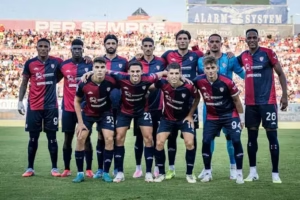
CLUB SNAPSHOT: At a Glance
| Category | Details |
|---|---|
| Club | Málaga CF |
| League | La Liga |
| Manager | Juan Funes |
| Stadium | La Rosaleda |
| Nickname | Los Boquerones |
| Founded | 1948 |
| First-Choice Midfield Trio | Dani Lorenzo / Carlos Dotor / Ramón Enríquez |
| Rotation Options | Izan Merino / Rafa Rodríguez / Pablo Martínez |
| Academy Prospect | Pablo Arriaza |
| Notable Arrival | Jens Cajuste (loan from Napoli) |
The Defining Moment
Málaga CF’s 2026/27 season has been defined by a midfield that was supposed to be the foundation of the club’s survival bid, yet has instead become the clearest illustration of the gap between Segunda División success and La Liga reality. The trio of Dani Lorenzo, Carlos Dotor, and Izan Merino—the engine room that powered promotion—were handed the keys to the top flight. The results have been sobering: a winless start, a place at the bottom of the table, and a midfield that has struggled to impose itself against superior opposition.
The defining moment of Málaga’s midfield season came not in a single match but in a statistical shift that tells the story of adaptation and struggle. Izan Merino, the malagueño pivot who was indispensable in Funes’s promotion-winning side, has seen his minutes collapse. In the first five matches before the October international break, he played 246 minutes. In the five matches since, that figure has dropped to just 61 minutes—a loss of 185 minutes of playing time. The arrival of Ramón Enríquez from injury and the emergence of Pablo Martínez have pushed Merino to the margins, a casualty of the step up in quality and the manager’s search for solutions.
The broader numbers reflect the collective struggle. Málaga’s midfield has contributed just one goal and one assist in La Liga this season, a return that underscores the difficulty of creating and converting chances at the highest level. Dani Lorenzo, the marbellí playmaker whose turns and vision were the compass of the promotion campaign, has yet to register a goal contribution. Carlos Dotor, the todocampista capable of playing as a six, eight, or ten, has one goal but has struggled with the ball at his feet, averaging 8.71 losses per match. The midfield that was supposed to be Málaga’s strength has become its most pressing concern.
This is the story of Málaga’s 2026/27 midfielders: a promotion-winning trio learning the hard way that La Liga is a different proposition, a veteran arrival searching for fitness, and a supporting cast navigating injuries and limited opportunities.
Tactical Context
Funes has cycled through multiple midfield configurations in search of a formula that works. The preferred shape has oscillated between a 4-1-4-1 and a 4-4-2, with a three-man midfield deployed in the five-at-the-back system that has been used in away fixtures. The intention is to provide defensive security while maintaining enough control in central areas to launch counter-attacks.
The most stable trio has been Dani Lorenzo, Carlos Dotor, and Ramón Enríquez. Ramón’s return from injury in October provided Funes with a physical presence in the pivot, a player capable of playing short and long passes and bringing the team together. His partnership with Lorenzo and Dotor gave Málaga their most cohesive midfield performance of the season in the 1-1 draw at Alavés, a match that Funes described as the team’s best away performance of the campaign.
The balance of the midfield has been complicated by the physical demands of La Liga. Izan Merino, the specialist pivot who sweeps the house, presses, and helps the centre-backs, has lost 70% of his duels this season, a statistic that illustrates the step up in physicality. Dotor, despite his energy and late runs into the box, has been guilty of too many turnovers, a flaw that was tolerated in the Segunda División but is punished ruthlessly in the top flight. Lorenzo, the creative fulcrum, has struggled to find the space and time that allowed him to dictate play last season.
The structural vulnerability is the lack of a midfielder who can consistently progress the ball under pressure. Málaga’s midfield has been forced to rely on long balls and transitions rather than sustained possession, a consequence of the quality gap between the Segunda División and La Liga. The arrival of Jens Cajuste, the Swedish international on loan from Napoli, was supposed to address this deficiency, but his fitness issues have limited him to just five minutes of league football.
The Midfielders
Dani Lorenzo
Lorenzo is Málaga’s creative fulcrum, the 23-year-old marbellí whose turns and vision were the defining feature of the promotion campaign. He has started seven of his nine league appearances, accumulating 613 minutes, but has yet to register a goal or assist.
His profile is that of the classic number ten: technically gifted, agile, and capable of creating superiority with a single turn. In the Segunda División, he was the compass of the team, the player who set the tempo and unlocked defences. In La Liga, the spaces are smaller, the defenders are faster, and the time on the ball is reduced. Lorenzo has struggled to adapt, his influence on matches diminished by the quality of opposition and the lack of a functioning structure around him.
The concern is not talent but adaptation. At 23, Lorenzo has time to develop, but Málaga’s survival bid cannot wait indefinitely. If he can find a way to impose himself on La Liga matches, Málaga have a creator capable of unlocking defences. If he cannot, the midfield will continue to struggle for creativity.
Carlos Dotor
Dotor is the todocampista of the midfield, the 25-year-old capable of operating as a six, an eight, or a ten. He has started eight of his nine league appearances, accumulating 641 minutes, and his one goal—against Villarreal—is one of only two league goals scored by Málaga midfielders this season.
His profile is that of the energetic, box-to-box midfielder: physical, aggressive in the press, and capable of arriving late in the box. His 8.71 losses per match is a concern, a statistic that reflects the difficulty of operating in central areas against La Liga opposition. But his physicality and his willingness to run are assets that Funes values, particularly in a team that relies on pressing and transitions.
At 25, Dotor is entering his prime. His development under Funes will determine whether he can become a reliable La Liga midfielder or whether he will remain a player whose qualities are better suited to the Segunda División.
Ramón Enríquez
Ramón is the veteran presence in the midfield, the 25-year-old who returned from injury in October and has since become one of Funes’s most trusted players. He has started seven of his ten league appearances, accumulating 613 minutes, and his physical presence in the pivot has provided the stability that Merino has lacked.
His profile is that of the complete pivot: capable of playing short and long, physically robust, and tactically intelligent. His performance against Alavés, where he controlled the team before being substituted in the 68th minute, demonstrated his importance to the structure. The concern is his fitness—he is still building towards full match sharpness after his injury, and his minutes must be managed carefully.
Izan Merino
Merino is the casualty of Málaga’s adaptation to La Liga, the 20-year-old pivot who was indispensable in the promotion campaign but has seen his minutes collapse in the top flight. He has started six of his eight league appearances, accumulating 553 minutes, but his influence on matches has diminished significantly.
His profile is that of the specialist destroyer: positionally disciplined, aggressive in the press, and capable of screening the back four. In the Segunda División, his physical limitations were masked by the quality of opposition. In La Liga, he has lost 70% of his duels, a statistic that illustrates the gap in physicality.
At 20, Merino has time to develop, but the arrival of Ramón and the emergence of Pablo Martínez have pushed him to the margins. The January window may offer an opportunity for a loan move to secure regular football, or he may remain as a squad option in Málaga’s relegation battle.
Rafa Rodríguez
Rafa is the physical alternative in the midfield, the 23-year-old whose physique is much more developed for Primera División and offers a different profile to Málaga’s more technical options. He has started four of his nine league appearances, accumulating 424 minutes, and his physicality and duel-winning ability make him a valuable squad member.
His role this season has been that of the rotation option, stepping in when Funes requires a more physical presence or when injuries deplete the midfield. At 23, he has time to develop, but the competition for places is fierce and his minutes have been limited.
Pablo Martínez
Pablo Martínez is the summer arrival from Levante, the 28-year-old whose experience and set-piece delivery have made him a valuable addition. He has started four of his eight league appearances, accumulating 220 minutes, and his assist for Adrián Niño against Celta Vigo demonstrated his quality from dead-ball situations.
His profile is that of the experienced, technically gifted midfielder: capable of playing in multiple central roles, reliable from set-pieces, and tactically intelligent. His plantar fasciitis has limited his availability, but when fit he provides a level of composure that the younger midfielders lack.
Jens Cajuste
Cajuste is Málaga’s marquee loan signing, the Swedish international from Napoli whose experience in the Premier League, Serie A, and Ligue 1 was supposed to transform the midfield. He has played just five minutes of league football due to a quadriceps injury sustained shortly after his arrival.
His profile is that of the complete defensive midfielder: physically imposing, technically secure, and capable of dictating tempo. When fully fit, he will provide Funes with an option that no other midfielder in the squad possesses. The question is whether his body can withstand the demands of La Liga and whether he can integrate quickly enough to make a difference in Málaga’s survival bid.
The Numbers Game
TABLE A: Málaga Midfielder La Liga Statistics (2026/27)
| Player | Apps (Starts) | Minutes | Goals | Assists | Yellow Cards |
|---|---|---|---|---|---|
| Carlos Dotor | 9 (8) | 641 | 1 | 0 | 2 |
| Dani Lorenzo | 9 (7) | 613 | 0 | 0 | 1 |
| Ramón Enríquez | 10 (7) | 613 | 0 | 0 | 1 |
| Izan Merino | 8 (6) | 553 | 0 | 0 | 0 |
| Rafa Rodríguez | 9 (4) | 424 | 0 | 0 | 1 |
| Pablo Martínez | 8 (4) | 220 | 0 | 1 | 1 |
| Jens Cajuste | 1 (0) | 5 | 0 | 0 | 0 |
TABLE B: Málaga Midfield – Key Metrics (La Liga 2026/27)
| Metric | Value | Context |
|---|---|---|
| Goals from Midfield | 1 | Dotor vs Villarreal |
| Assists from Midfield | 1 | Pablo Martínez vs Celta |
| League Position | 20th | 5 points from 10 matches |
| Goals Scored (League) | 7 | 0.70 per game |
| Goals Conceded (League) | 19 | 1.90 per game |
TABLE C: Midfielder Physical & Possession Metrics (2026/27)
| Metric | Dotor | Merino | Ramón | Context |
|---|---|---|---|---|
| Duels Won (%) | — | 30% | — | Physical contest success |
| Losses per Match | 8.71 | — | — | Possession retention |
| Minutes per Appearance | 71.2 | 69.1 | 61.3 | Consistency of selection |
| Contract Status | Loan | Academy | Long-term | Stability vs transition |
Tactical Identity & Squad Balance
Málaga’s midfield is a study in adaptation under duress. The promotion-winning trio of Lorenzo, Dotor, and Merino was supposed to provide continuity and cohesion, but the step up in quality has exposed their limitations. The arrival of Ramón and Pablo Martínez has provided alternatives, but the midfield remains a work in progress.
The balance is functional rather than fluid. Ramón provides physical presence in the pivot. Dotor offers energy and late runs. Lorenzo supplies creativity, albeit inconsistently. The supporting cast—Merino, Rafa, Pablo Martínez, Cajuste—provides depth and different profiles, but the lack of a consistent, controlling presence in central areas has been a recurring problem.
The structural vulnerability is the lack of a midfielder who can consistently progress the ball under pressure. Málaga’s possession statistics have been respectable—47% against Atlético, 58% against Espanyol—but the quality of that possession has been lacking. The midfield has been forced to rely on long balls and transitions rather than sustained control, a consequence of the quality gap between the Segunda División and La Liga.
The Verdict from the Camp
Diario Sur, on the midfield options:
“With the return of Cajuste, the only unavailable midfielder is Aaron Ochoa, meaning the range of possibilities is at its widest. The midfield is more than covered at Málaga. Funes has seven midfielders (the Swede, Izan Merino, Pablo Martínez, Dotor, Ramón, Dani Lorenzo and Rafa), in principle for three positions.”
On the struggles of the promotion trio:
“The three midfielders with the most minutes are the ones who formed the undisputed trio for Funes last season in Segunda División and who, of course, worked wonders: Izan Merino (437), Dotor (495) and Dani Lorenzo (500). However, each is going through some difficulties, a logical fact given they are young players with little or no previous experience in Primera División.”
SPORT, on Izan Merino’s decline:
“The most striking situation is the one Izan Merino is experiencing. The malagueño has played a total of 61 minutes in the last five matches. In the five before the first FIFA Window—Real Madrid, Levante, Celta, Villarreal and Getafe—they were 246. That is, the academy graduate has lost 185 minutes between the first stretch and the second.”
Radio Marca Málaga, on the tactical system:
“Ramón, surrounded defensively to cover his deficiencies, provides a huge amount with the ball. A midfielder capable of playing short, long, and bringing the team together.”
Where Next?
Málaga’s midfield priority is adaptation. The promotion-winning trio of Lorenzo, Dotor, and Merino must find a way to translate their Segunda División success into La Liga performances. The step up in quality has exposed their limitations, but at 20, 23, and 25 respectively, they have time to develop.
The return of Cajuste to full fitness is the most immediate hope. The Swedish international’s experience and quality could provide the controlling presence that the midfield has lacked. If he can stay fit and adapt to Funes’s system, Málaga have a midfielder capable of transforming their possession game.
The January window may offer an opportunity to address the midfield’s creative deficit, but the club’s financial constraints and the priority of survival make significant investment unlikely. The focus will remain on extracting more from the players already at Funes’s disposal.
For now, the Boquerones have a midfield that has been functional but not fluent, industrious but not incisive. The statistical profile is damning—one goal and one assist from central areas in ten matches—and the reliance on the forward line for attacking output is unsustainable. The question is not whether Málaga’s midfield has talent—Lorenzo’s vision, Dotor’s energy, and Ramón’s composure suggest it does. The question is whether it can find the quality and consistency required to compete in La Liga. If it can, Funes’s first campaign has a foundation. If it cannot, the midfield will remain the weakest link in a season that is already slipping away.