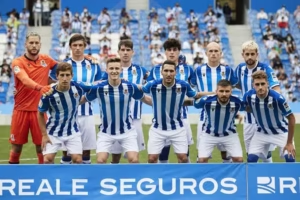
CLUB SNAPSHOT: At a Glance

| Category | Details |
|---|---|
| Club | Deportivo Alavés |
| League | La Liga |
| Manager | Quique Sánchez Flores |
| Stadium | Mendizorroza |
| Nickname | Babazorros |
| Founded | 1921 |
| Leading Scorer | Lucas Boyé (5 goals) |
| Veteran Option | Mariano Díaz |
| Supporting Cast | Toni Martínez, Aitor Mañas, Miguel Rodríguez |
| Current League Position | 7th (12 points from 10 matches) |
The Defining Moment
Deportivo Alavés’ forward line entered 2026/27 with a question that had followed the club through years of relegation battles and mid-table consolidations: where would the goals come from? The answer, in the opening months, has been unexpected. Lucas Boyé, the 30-year-old Argentine who arrived from Granada in the summer of 2025, has emerged as the focal point of Quique Sánchez Flores’ attack, scoring five goals in eleven appearances across all competitions. It is a return that has surprised even the most optimistic of Babazorros supporters.
The defining moment of the season came not in a victory, but in a defeat. On 18 October, Alavés travelled to Balaídos and lost 2-1 to Celta Vigo. The scoreline was narrow, but the performance was revealing: Alavés registered 20 shots, nine on target, and still lost. It was a game that encapsulated both the promise and the limitation of Quique’s forward line. The chances were being created. The finishing was not always there.
By late October, Alavés sat seventh in La Liga with 12 points from ten matches, a position that exceeded pre-season expectations. The forwards had contributed eight of the team’s 14 league goals, a distribution that suggested a collective rather than individual threat. But the margin was thin. A few missed chances here, a few saves there, and the top-half position could quickly become a relegation battle.
This is the story of Alavés’ 2026/27 forwards: an Argentine finding his form at the right time, a Dominican veteran providing experience from the bench, and a supporting cast of hard-working professionals searching for consistency in a system that demands everything of its front line.
Tactical Context
Quique’s Alavés is a team built on defensive organisation and opportunistic attacking. The veteran coach, who took over in March and steered the club to safety, has constructed a side that is comfortable without the ball but capable of hurting opponents on the break. The numbers reflect this: Alavés average just 42.9% possession, among the lowest in La Liga, yet they have scored 14 goals in ten matches — a return of 1.40 per game that places them in the middle of the division.
The forward line in Quique’s 4-4-2 (which alternates with a 5-3-2 depending on the opponent) is built around a central striker supported by wide forwards who drift inside. The system demands mobility, pressing, and a willingness to run into channels. It is not a structure designed for a static target man; it is a structure that requires forwards who can contribute to the defensive effort as much as the attacking one.
Lucas Boyé has embodied those demands. The Argentine, standing 181 centimetres, is not the most physically imposing striker in La Liga, but his movement and work rate have made him indispensable. His five goals in eleven appearances — including a brace against Osasuna in the 5-2 victory — have come from a combination of intelligent positioning and clinical finishing. He is not a player who creates something from nothing; he is a player who converts the chances that his teammates provide.
Around Boyé, the supporting cast has been rotated. Mariano Díaz, the 33-year-old Dominican veteran, has contributed four goals and four assists in twelve appearances, a remarkable return for a player who has started fewer than half of those matches. Toni Martínez, the 29-year-old Spaniard, has started regularly but has yet to score, his contribution measured in hold-up play and defensive work rather than goals. Aitor Mañas, the 23-year-old academy graduate, has one goal in limited minutes.
The attacking output has been sufficient, but the margins are thin. Alavés have scored more than one goal in a match only four times in ten league fixtures. The 5-2 victory over Osasuna remains the outlier, a performance in which everything clicked. The challenge for Quique is to find a way to replicate that fluidity more consistently, without sacrificing the defensive solidity that has kept his team in the top half.
The Forwards
Lucas Boyé
Boyé is the leading scorer and the focal point of Alavés’ attack. The 30-year-old Argentine, who arrived from Granada in August 2025, has thrived in Quique’s system, his movement and finishing providing the goals that the team desperately needed. His profile is that of the intelligent, hard-working centre-forward: he is not the tallest, nor the fastest, but he reads the game well, finds space in the box, and converts his chances with commendable efficiency.
The numbers from 2026/27 reflect his importance. Five goals in eleven appearances across all competitions, including a brace in the 5-2 victory over Osasuna, have made him the club’s leading scorer. His wages — approximately €2.08 million annually — reflect his status as one of the squad’s higher earners, a sign of the responsibility that Quique has placed on his shoulders.
At 30, Boyé is in his prime. He is not a long-term solution, but he is precisely the kind of reliable, productive forward that a club of Alavés’ resources needs. If he can maintain his current form, the club’s top-half position will be sustainable. If he falters, the alternatives are limited.
Mariano Díaz
Mariano is the veteran of the forward line and the most surprising contributor of the season. The 33-year-old Dominican, who has played for Real Madrid and Sevilla, arrived at Mendizorroza in August 2025 with modest expectations. His role was expected to be that of an experienced backup, a player who could provide cover and leadership from the bench.
Instead, he has become one of the team’s most productive attackers. Four goals and four assists in twelve appearances — despite starting fewer than half of those matches — is a remarkable return for a player whose minutes have been carefully managed. His ability to make an impact as a substitute has been invaluable, providing Quique with a plan B when the starting forwards are struggling to break through.
His profile is that of the experienced poacher: he does not contribute much to the build-up, but he has an instinct for being in the right place at the right time. His wages — approximately €1.56 million annually — reflect his status as a squad player rather than a starter, but his contributions have exceeded that designation.
At 33, Mariano is in the twilight of his career. His value to Alavés is not as a long-term solution but as a short-term one, a player who can provide goals and experience in equal measure.
Toni Martínez
Martínez is the enigma of Alavés’ forward line. The 29-year-old Spaniard, who arrived from Porto in August 2024, has started regularly in Quique’s system, his hold-up play and defensive work providing the platform for Boyé and the wide forwards. But his goal return — zero in eleven appearances — is a source of frustration for a player who was signed to score.
His profile is that of the traditional target man: tall, physically imposing, capable of winning aerial duels and bringing others into play. In a system that relies on the forwards to press and cover ground, Martínez’s mobility is a limitation. He is at his best when the team is defending a lead, holding the ball up in the corners, and relieving pressure on the defence.
At 29, Martínez should be in his prime. Whether he can rediscover the goalscoring form that persuaded Alavés to invest in him is one of the season’s more pressing questions.
Aitor Mañas
Mañas is the academy graduate who has been given opportunities in the first team. The 23-year-old from Vitoria has one goal in nine appearances, his minutes limited by the form of Boyé and Mariano. His profile is that of the developing forward: mobile, willing to run in behind, and learning the demands of top-flight football.
At 23, Mañas has time to develop. But in a team that needs goals now, his opportunities may be limited. His long-term future at Mendizorroza is likely to depend on whether he can establish himself as a reliable squad option over the next season or two.
Miguel Rodríguez
Rodríguez is the young winger who has been used sparingly in the opening months. The 23-year-old, who arrived from FC Utrecht in the summer, has made just three appearances, his minutes limited to eleven. His profile is that of the direct, pacey wide forward: he can beat his man, deliver crosses, and stretch defences.
At 23, Rodríguez is a project rather than a solution. His adaptation to La Liga is ongoing, and his opportunities will likely increase as the season progresses and rotation becomes necessary. Whether he can fulfil his potential at Mendizorroza remains to be seen.
Abde Rebbach
Rebbach is the wide forward who has started most consistently alongside Boyé. The 28-year-old Algerian has made twelve appearances, completing 881 minutes, but has yet to score or assist. His profile is that of the hard-working wide midfielder: he covers ground, presses opponents, and provides width in a system that relies on the full-backs for offensive support.
His contribution is measured in defensive work and tactical discipline rather than goals and assists. In a team that lacks creativity from midfield, Rebbach’s limitations in the final third are a concern. But his work rate and reliability have made him a fixture in Quique’s starting line-up.
The Numbers Game
Table A: Deportivo Alavés Forward La Liga Statistics (2026/27)
| Player | Apps (Starts) | Minutes | Goals | Assists | Notes |
|---|---|---|---|---|---|
| Lucas Boyé | 11 (11) | 887 | 5 | 0 | Leading scorer; focal point |
| Mariano Díaz | 12 (4) | 475 | 4 | 4 | Impact substitute; productive |
| Toni Martínez | 11 (8) | 617 | 0 | 0 | Hold-up play; no goals |
| Abde Rebbach | 12 (11) | 881 | 0 | 0 | Wide forward; defensive work |
| Aitor Mañas | 9 (1) | 156 | 1 | 0 | Academy graduate; limited minutes |
| Miguel Rodríguez | 3 (0) | 11 | 0 | 0 | Summer signing; adapting |
Table B: Deportivo Alavés Forward Unit – Key Metrics (2026/27)
| Metric | Value | Context |
|---|---|---|
| Team Goals per Game | 1.40 | 14 goals in 10 league matches |
| Boyé Goals per 90 | 0.51 | Leading scorer |
| Mariano Goals per 90 | 0.76 | Best ratio in squad |
| Shots vs Celta Vigo (Away) | 20 | 9 on target; 1 goal |
| Shots vs Osasuna (Home) | 12 | 7 on target; 5 goals |
Table C: Forward Career Context & Pedigree
| Player | Nationality | Previous Clubs | Style Profile |
|---|---|---|---|
| Lucas Boyé | Argentina | Granada, Torino | Intelligent centre-forward, movement, finishing |
| Mariano Díaz | Dominican Republic | Real Madrid, Sevilla | Experienced poacher, impact substitute |
| Toni Martínez | Spain | Porto, Famalicão | Target man, hold-up play, aerial |
| Abde Rebbach | Algeria | — | Hard-working wide forward, defensive contribution |
| Aitor Mañas | Spain | Alavés Academy | Developing forward, mobile, learning |
| Miguel Rodríguez | Spain | FC Utrecht | Direct winger, pace, adapting to La Liga |
Tactical Identity & Squad Balance
Alavés’ forward line is a study in function over flair. The numbers tell a story of collective productivity rather than individual brilliance: 14 goals in ten matches, spread across Boyé, Mariano, and the midfield, with no single player dominating the scoring charts. It is a distribution that reflects Quique’s system, which asks the forwards to contribute defensively and the goals to come from a variety of sources.
The balance between Boyé and Mariano has been the most encouraging aspect of the season. Boyé provides the movement and link-up play; Mariano provides the finishing and experience from the bench. Together, they have scored nine of Alavés’ 14 league goals, a contribution that has sustained the club’s top-half position. The concern is that both are in their thirties, and neither is a long-term solution.
Toni Martínez’s lack of goals is the most significant individual underperformance. The Spaniard has started eight of Alavés’ ten league matches, completing 617 minutes, but has yet to find the net. His hold-up play and defensive work have been valuable, but in a team that struggles to create chances, a striker who cannot convert them is a luxury that Quique can ill afford.
The depth is adequate but not abundant. Mañas and Rodríguez provide youth and energy, but neither has established himself as a reliable contributor. The loss of Boyé to injury or suspension would leave Alavés reliant on Mariano and Martínez, a pairing that lacks the movement and dynamism that Quique’s system demands.
The January window may offer an opportunity to add another forward, but the club’s financial constraints make significant investment unlikely. The priority, if any, would be a wide forward who can provide goals and creativity from the flanks, easing the burden on Boyé and Mariano.
The Verdict from the Camp
Quique Sánchez Flores, on his attacking ambitions:
“The idea is for people to enjoy the team and not to live with the rope around their neck. The first idea, in the short term, is to secure survival, but then we want to grow and even dream of Europe.”
FBref, on Alavés’ season:
“Record: 3-3-4, 12 points (1.20 per game), 7th in La Liga. Goals: 14 (1.40 per game), Goals Against: 11 (1.10 per game), Diff: 3.”
ScoutingStats.AI, on the forward unit:
“Lucas Boyé: 11 apps, 887 mins, 5 goals. Mariano Díaz: 12 apps, 475 mins, 4 goals, 4 assists.”
Where Next?
Alavés’ forward priority is clear: they need Boyé to stay fit, and they need Mariano to continue his remarkable impact from the bench. The pairing has produced nine goals between them, a return that has sustained the club’s surprising top-half position. But both are in their thirties, and neither is a long-term solution.
The development of Mañas and Rodríguez is the secondary subplot. Both are young, both have potential, and both need minutes to develop. Whether they can seize those opportunities when they arise will determine whether Alavés’ forward line becomes a strength in future seasons, even if it cannot be one now.
Toni Martínez’s form is the most pressing individual question. The Spaniard has started regularly but has yet to score. If he can rediscover his finishing touch, Alavés will have a third reliable goalscoring option. If he cannot, the burden on Boyé and Mariano will become unsustainable.
For now, Alavés’ forwards are a unit defined by efficiency. Boyé leads, Mariano delivers from the bench, and the supporting cast provides depth without drama. The question is whether efficiency is enough for a club with Alavés’ ambitions. The early-season evidence suggests it might be — as long as the goals keep coming and the top-half position holds.