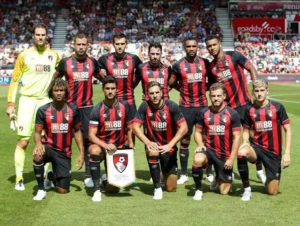
Benfica enter the 2026/27 campaign in the midst of a quiet revolution. After three consecutive seasons without the Portuguese title, the club appointed Marco Silva in the summer of 2026, replacing Jose Mourinho who departed for Real Madrid. Silva, returning to Portuguese football after a decade abroad, most recently with Fulham, inherits a squad in transition. For the first time since 2022/23, Benfica are absent from the Champions League. The departures of veteran centre-backs Nicolas Otamendi and Antonio Silva forced a complete defensive rebuild. Yet the early signs are encouraging: five league matches, four wins, one draw, eighteen goals scored, and only three conceded. This is the definitive guide to the current Benfica squad.
Technical Leadership & Coaching Profile
Manager: Marco Silva
Tactical Philosophy: Silva has implemented a more controlled, possession-oriented style than his predecessor. Portuguese media analysis notes that compared to Mourinho’s Benfica, Silva’s team “plays more” — emphasising ball retention and proactive attacking organisation. The attacking ceiling is among the highest in the Primeira Liga, with Vangelis Pavlidis, Gianluca Prestianni, Rafa Silva, and Bruma offering multiple ways to construct the forward line. Defensively, Silva has focused on rebuilding a back line stripped of its two most experienced figures, with Clement Lenglet emerging as the anchor of that reconstruction.
Preferred Formations: 4-2-3-1. Silva established this system across the opening fourteen competitive matches. The double pivot of Joao Palhinha and Fredrik Aursnes was first deployed in the difficult away fixtures at Milan and Porto, and has remained the preferred midfield structure.
Strategic Transfer Activity
Benfica’s summer strategy was pragmatic and efficient, prioritising defensive reinforcement while adding proven attacking quality at manageable cost. The marquee arrival was Joao Palhinha, whose signing was described as the “loudest” of the window.
Table A: Summer Major Transfer Influx
| Player | Position | Former Club | Fee Paid |
|---|---|---|---|
| Joao Palhinha | Defensive Midfielder | Bayern Munich | Undisclosed |
| Clement Lenglet | Centre-Back | Atletico Madrid | Free |
| Alessandro Circati | Centre-Back | Parma | €20m |
| Joao Duran | Forward | Al Nassr | Loan (€6.1m) |
| Jakub Kaminski | Winger | FC Koln | Undisclosed |
| Gabriel Indio | Centre-Back | Atletico Mineiro | Undisclosed |
Joao Palhinha’s arrival is the central piece of Silva’s tactical blueprint. The Portuguese international provides defensive solidity and game reading in the double pivot, liberating Aursnes to advance into more attacking positions. Clement Lenglet joined on a free transfer from Atletico Madrid and was immediately appointed to the leadership group. His experience at the heart of defence is critical for a young back line. Alessandro Circati arrived from Parma for €20 million on a five-year contract until 2031. The 22-year-old Australian international can operate in both a back four and a back three, and is viewed as a long-term defensive cornerstone. Joao Duran joined on loan from Al Nassr with a €30 million purchase option. The 22-year-old Colombian forward scored on his Europa League debut against Hearts.
The First-Team Roster
Goalkeepers
Samuel Soares (#1): One of the most significant changes under Silva. Soares has displaced Anatoliy Trubin as the starting goalkeeper, accumulating 990 minutes across the opening eleven matches. The Portuguese goalkeeper’s consistency has provided stability behind a rebuilt defence, and his market value has risen accordingly.
Anatoliy Trubin (#): The Ukrainian goalkeeper has lost his starting position. In Silva’s rotation, he remains a reliable backup, though his market valuation has declined by €5 million.
Defenders
Clement Lenglet (#): The French centre-back is the natural replacement for Otamendi. Lenglet has appeared in thirteen of the first fourteen matches, accumulating 1,045 minutes, among the highest in the squad. His experience and ball-playing ability are essential to Silva’s possession system, and he has been included in the leadership group.
Tomas Araujo (#): The young Portuguese centre-back has inherited Antonio Silva’s position. Araujo has appeared in twelve matches, accumulating 1,004 minutes, and has contributed one assist. His development is central to Benfica’s defensive reconstruction.
Alexander Bah (#): After an injury-disrupted 2025/26 campaign, Bah has reclaimed his starting role under Silva, accumulating 805 minutes in the opening ten matches.
Samuel Dahl (#): The Swedish left-back is one of Silva’s most trusted players, accumulating 1,065 minutes in the opening thirteen matches, the highest in the squad.
Amar Dedic (#): The Bosnian international provides competition and depth at right-back.
Gabriel Indio (#): The 17-year-old Brazilian centre-back joined from Atletico Mineiro as a long-term defensive investment.
Midfielders
Fredrik Aursnes (#): The Norwegian midfielder was appointed captain by Silva following Otamendi’s departure. His versatility and tactical intelligence make him indispensable to Silva’s system.
Joao Palhinha (#): The most important summer signing. Palhinha provides the defensive screen in the double pivot, his interception and duel-winning ability allowing Aursnes to advance into attacking positions.
Leandro Barreiro (#): The Luxembourg midfielder is one of Silva’s most-used players, accumulating 844 minutes in the opening thirteen matches, with two goals and one assist. His late runs into the box and finishing ability are a valuable supplement to Benfica’s attack.
Enzo Barrenechea (#): The Argentine midfielder received significant opportunities in the early weeks, accumulating 677 minutes in eleven matches. However, Palhinha’s arrival and Barreiro’s emergence have compressed his playing time. A serious injury sustained before the Porto derby has further complicated his season.
Georgiy Sudakov (#): The Ukrainian midfielder has accumulated 285 minutes across five league appearances, providing technical quality and creativity.
Manu Silva (#): The Portuguese midfielder has also featured in Silva’s rotation and has been trialled as a centre-back option.
Forwards
Vangelis Pavlidis (#): The Greek striker is the focal point of Benfica’s attack. Six goals and two assists in five league matches, an average of 1.45 goals per game. His movement and finishing ensure Benfica always carry a threat in the box.
Gianluca Prestianni (#): The Argentine attacking midfielder has enjoyed a breakout under Silva. Four goals and two assists in five league matches, averaging 1.33 goal involvements per game. His market value has soared from €20 million to €40 million, the largest increase in the Primeira Liga. Silva’s trust has propelled Prestianni into an “explosive phase” of his career.
Rafa Silva (#): The 33-year-old Portuguese attacker has firmly established himself as a starter since his winter return and continues to play an important role under Silva. His experience and technical quality provide stability in a young forward line.
Joao Duran (#): The Colombian forward scored on his Europa League debut, demonstrating immediate impact. As a rotation option and partner for Pavlidis, Duran’s pace and physicality offer a different attacking dimension.
Bruma (#): The Portuguese winger provides width and one-on-one ability, an important option on the flanks.
Jakub Kaminski (#): The Polish winger joined from Koln, adding depth and competition in wide areas.
Leadership Group & Squad Regulations
Club Captain: Fredrik Aursnes
Following the departures of Otamendi and Antonio Silva, Silva appointed Aursnes as first captain. The full captaincy hierarchy is: Aursnes, Tomas Araujo, Samuel Soares, Lenglet, and Leandro Barreiro. This structure preserves continuity through Aursnes, Araujo, and Soares, who were already in the leadership sequence last season, while incorporating the experience and leadership of new arrivals Lenglet and Barreiro.
Homegrown Quota Check: Benfica incorporated more than one-third of their Seixal academy graduates into pre-season training. Seventeen players developed at Benfica participated in pre-season, including Samuel Soares, Diogo Ferreira, Andre Gomes, Bajaki, Jose Neto, Joao Fonseca, Wendel, Rui Silva, Miguel Figueiredo, Gonzalo Moreira, Rafael Luis, Joao Rego, Jaden Umeh, Anisio Cabral, Edokpolor, and Tiago Gouveia. Joao Rego, Gonzalo Oliveira, and Rodrigo Rego are expected to depart on loan to gain playing time.
Financial & Contractual Health
Financial Balance Overview: Benfica’s squad market value has increased by €50 million to €422 million, overtaking Sporting CP as the second-most valuable squad in the Primeira Liga, behind only Porto at €470.5 million. Prestianni’s doubled valuation is the primary driver of this growth. The arrivals of Palhinha and Lenglet were completed at relatively controlled cost, the former for an undisclosed fee and the latter on a free transfer, reflecting the club’s ability to operate shrewdly within financial constraints.
Contract Red Alerts: Duran’s loan agreement includes a €30 million purchase option, which Benfica will evaluate at season’s end. Circati signed a five-year contract until 2031, demonstrating the club’s commitment to long-term defensive construction. The outstanding performances of Pavlidis and Prestianni will inevitably attract interest from Europe’s elite clubs, and Benfica must prepare for potential offers.
The Academy Pipeline & Loan Tracker
Breakout Talents to Watch: Joao Fonseca, a 19-year-old centre-back, entered the matchday squad under Mourinho but has yet to make his official debut. Miguel Figueiredo, a 17-year-old midfielder and U17 World Cup winner, is rising rapidly. Gonzalo Moreira, a 20-year-old midfielder, contributed seven goals and six assists for the B team and has already made his first-team debut. Jaden Umeh, an 18-year-old winger, has already represented the Republic of Ireland at senior level, his pace and trickery highly anticipated. Peter Edokpolor, a 19-year-old forward standing 1.92 metres tall, scored four goals in 22 B team appearances.
Notable Out on Loan: Joao Rego is expected to depart on loan to secure regular playing time, with his destination dependent on the new coaching staff’s assessment. Gonzalo Oliveira has attracted interest from French clubs, with Lens and Strasbourg potential destinations. Rodrigo Rego’s future remains uncertain, with a permanent transfer or loan departure both possible.
Set-Piece Specialists & FPL Cheat Sheet
Penalties: Vangelis Pavlidis (First Choice). Pavlidis has already converted one penalty in five league matches and is the undisputed first-choice taker.
Direct Free-Kicks: Georgiy Sudakov / Gianluca Prestianni.
Corners & Crosses: Samuel Dahl and Alexander Bah are the primary sources of width, with Sudakov and Prestianni responsible for dead-ball delivery.
For Fantasy Primeira Liga managers, Pavlidis is the most efficient asset. Six goals and two assists in five league matches, averaging 1.93 goal involvements per game, make him one of the league’s most lethal forwards. Prestianni’s breakout makes him a premium midfield option, with four goals and two assists, and a market value of €40 million reflecting his emergence. Lenglet’s defensive stability and Barreiro’s midfield goal threat are also worth monitoring.
Final Outlook: Navigating the Tactical Horizon
Benfica enter October with four wins and one draw from five league matches, thirteen points, eighteen goals scored, and three conceded, a goal difference of plus fifteen. The away record is particularly impressive: three wins from three on the road. Silva’s quiet revolution is producing results. The team controls possession more fluidly, the attack possesses two in-form scorers in Pavlidis and Prestianni, and the defence is stabilising under Lenglet’s leadership.
The primary concern is midfield depth. Barrenechea’s serious injury leaves the Palhinha-Barreiro partnership without reliable rotation, and Sudakov and Manu Silva have yet to fully earn Silva’s absolute trust. In attack, Duran’s integration has been encouraging, but Pavlidis’s form is the lifeblood of Benfica’s offence, and any injury could have a significant impact on the season.
Benfica’s absence from the Champions League is both a financial loss and a competitive opportunity. The reduced pressure of the Europa League allows Silva to focus greater resources on the league, challenging Porto and Sporting CP’s dominance. If Pavlidis stays fit, Prestianni continues to develop, and the Lenglet-led defence proves itself in the toughest fixtures, Benfica have the quality to end their three-year title drought. The objective is clear, the path is visible, and the quiet revolution is waiting to be heard.