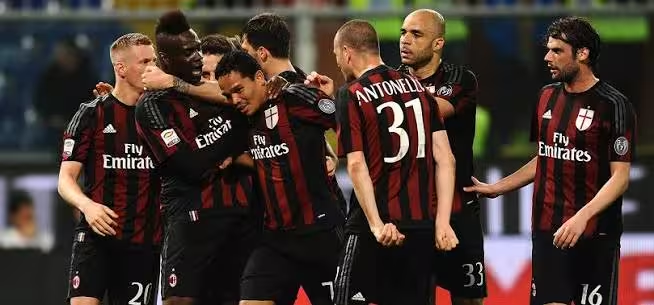
Following a summer of sweeping transformation, AC Milan underwent a complete restructuring of both management and coaching staff under direct ownership intervention. After two consecutive seasons without Champions League football, Gerry Cardinale personally oversaw the managerial appointment, with former Manchester United boss Rúben Amorim taking charge. Sporting director Igli Tare and technical director Geoffrey Moncada departed, while CEO Giorgio Furlani also left the club. Milan backed Amorim’s rebuild with record investment, posting one of Serie A’s highest net spends with the explicit target of returning to Europe’s elite competition.
Technical Leadership & Coaching Profile
Manager: Rúben Amorim
Amorim arrived at San Siro in summer 2026, replacing the dismissed Massimiliano Allegri. The Portuguese coach’s brief spell at Manchester United ended in failure — dismissed after a poor start to 2025/26 and replaced by Michael Carrick — but his track record at Sporting CP was enough to convince Milan: two Primeira Liga titles, three Taça da Liga crowns, and a Supertaça Cândido de Oliveira. Amorim was unambiguous at his unveiling: “We have a squad capable of winning every match in any competition. In the Europa League, we must believe and want to win it; in Serie A, I cannot say we don’t want to win.”
His first task was reshaping the team’s tactical identity. Allegri’s rigid 3-5-2 was abandoned in favour of a more fluid 3-4-2-1, with a 4-2-3-1 variant demonstrated against Lecce. Amorim’s use of Christian Pulisic proved particularly significant — he stated explicitly that the American’s best position is “a left-footer on the left,” a declaration that effectively narrowed Rafael Leão’s space on the left wing.
Tactical Philosophy
Amorim’s system is built on fluidity and space creation. Unlike Allegri’s static back-three structure, Amorim’s 3-4-2-1 grants the front players considerable positional freedom. Pulisic is no longer tethered to a second-striker role but can drift freely between central and wide areas, exploiting the narrow gaps between Italian defensive lines.
Defensively, Amorim carries the high-pressing principles from his Sporting CP tenure but has shown pragmatism in adapting to Serie A. Against Lecce, he switched to a back four to create new attacking channels — an adjustment that proved effective. On set-pieces, Milan excelled at both ends last season in Serie A — scoring eight and conceding only five from corners and indirect free-kicks — with Luka Modrić and Davide Bartesaghi’s delivery quality the foundation of that advantage.
Preferred Formations
3-4-2-1 / 4-2-3-1 in possession.
Strategic Transfer Activity
Milan’s summer window operated on a “quality over quantity” principle, with Cardinale sanctioning record investment. The three marquee signings — Mario Gila, Gonçalo Ramos, and Diego Moreira — cost over €150 million combined, with the Ramos deal breaking Milan’s transfer record.
Table A: Summer Major Transfer Influx
| Player | Position | Former Club | Fee Paid |
|---|---|---|---|
| Mario Gila | Centre-Back | Lazio | ~€30m |
| Gonçalo Ramos | Striker | Paris Saint-Germain | ~€75m |
| Diego Moreira | Left Winger | Strasbourg | €65m (incl. bonuses) |
| Sankon Diawara | Centre-Back | Troyes | ~€3m |
| Adrien Rabiot | Midfielder | — | Free transfer |
| Luka Modrić | Midfielder | — | Free transfer |
The Gila deal had been initiated before Tare’s departure, with the Spanish centre-back revealing that a personal call from Amorim persuaded him to reject Napoli and Atalanta. Diawara is viewed as a long-term successor to Strahinja Pavlović, his left-footed profile perfectly suited to the left centre-back role in Amorim’s back three.
The First-Team Roster
Goalkeepers
Mike Maignan (#16): The French international remains Milan’s last line of defence, his reaction speed and sweeping range among the best in Europe. His contract situation warrants monitoring, but he remains undisputed first choice in the short term.
Pietro Terracciano (#1): The experienced backup goalkeeper has provided reliable rotation cover since arriving in 2025.
Lorenzo Torriani (#35): An academy graduate whose market value rose by €1.2m earlier this season, showing developable potential.
Defenders
Mario Gila (#5): The €30m signing from Lazio is widely regarded as Milan’s best piece of summer business. His adaptation has been remarkably quick, establishing himself as the defensive cornerstone after just five league matches. Gila’s value extends beyond defending — he frequently advances into full-back positions during build-up, with his one-on-one defending and open-field speed drawing particular praise. Former Italian football commentator Sandro Sabatini remarked: “With Gila, Ramos, and Moreira, this team can go far.”
Strahinja Pavlović: The Serbian centre-back’s physicality and aerial dominance are vital weapons at both ends, his height contributing key goals in Allegri’s set-piece system.
Koni De Winter (#4): The young Belgian centre-back, whose market value has risen to €25m, has found a defined role in Amorim’s back three.
Fikayo Tomori (#23): The English centre-back’s situation is sobering. His market value has plummeted from €17m to €10m — the largest depreciation in Serie A. Amorim initially excluded him from plans after pre-season, but a shortage of defensive signings forced his reintegration. He has yet to receive any league minutes, and a winter departure appears almost certain.
Matteo Gabbia: An academy graduate providing local identity and tactical discipline to the defensive unit.
Davide Bartesaghi: The young full-back’s delivery quality has made him a set-piece asset, his crossing from wide areas offering a consistent attacking outlet.
Sankon Diawara: The low-cost arrival from Troyes is a development project, his left-footed profile offering long-term cover at left centre-back.
Alessandro Florenzi: The veteran full-back provides experience and versatility across both flanks, though his minutes will be managed carefully.
Midfielders
Luka Modrić (#14): The Croatian maestro remains the technical heart of the team at 41. His passing range, tempo control, and set-piece delivery are unmatched in the squad. Amorim has carefully managed his minutes, but Modrić’s influence in big matches remains decisive.
Adrien Rabiot (#12): The French international’s physicality and box-to-box energy provide the engine room. His late runs into the penalty area have already produced goals, and his partnership with Modrić offers a blend of steel and silk.
Youssouf Fofana (#29): The French midfielder’s defensive screening and ball-winning ability are central to Amorim’s structure, his athleticism covering ground across the midfield.
Tijjani Reijnders (#8): The Dutch midfielder’s progressive carrying and shooting from distance add an attacking dimension, his late runs into the box a recurring threat.
Ismaël Bennacer (#7): The Algerian’s injury record remains a concern, but when fit, his tenacity and distribution offer a reliable option in the double pivot.
Ruben Loftus-Cheek (#18): The English midfielder’s physical presence and dribbling ability provide a different profile, though his best role within Amorim’s system remains a question.
Warren Bondo (#38): The young French midfielder offers depth and defensive coverage, his development monitored closely.
Yunus Musah (#80): The American’s versatility across midfield and wide roles makes him a useful squad option, his athleticism suited to Amorim’s pressing demands.
Forwards
Gonçalo Ramos (#9): The club-record signing from Paris Saint-Germain is Milan’s attacking focal point. His movement, link-up play, and finishing instincts offer a complete centre-forward profile. The €75m investment carries significant expectation, but his early performances suggest he can deliver the goals that have been missing since Olivier Giroud’s departure.
Christian Pulisic (#11): The American has flourished under Amorim, his repositioning to the left side unlocking his best form. His direct running, finishing, and set-piece delivery make him one of the squad’s most important attacking players. Amorim’s public endorsement of his best position has cemented his status.
Rafael Leão (#10): The Portuguese winger’s situation is the most intriguing subplot of the season. Amorim’s preference for Pulisic on the left has compressed Leão’s space, and the 27-year-old faces a fight for minutes. His explosive pace and dribbling remain unmatched in the squad, but his tactical fit under the new manager is uncertain. A January departure cannot be ruled out.
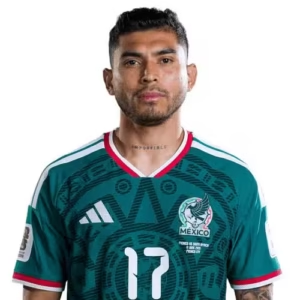
Diego Moreira (#17): The €65m signing from Strasbourg is a long-term investment. The Portuguese-Belgian winger’s directness and acceleration offer a different profile to Leão, and his development will be carefully managed.
Santiago Giménez (#15): The Mexican striker provides competition for Ramos, his work rate and movement in the box offering a reliable alternative.
Luka Jović (#22): The Serbian forward offers depth across the attacking line, though his future at the club remains uncertain.
Noah Okafor (#20): The Swiss forward’s versatility across the front line provides valuable squad depth.
Samuel Chukwueze (#21): The Nigerian winger offers pace and directness from the right, though consistency remains elusive.
Leadership Group & Squad Regulations
Club Captain: Mike Maignan
The French goalkeeper wears the armband, his presence and standards-setting influence anchoring a dressing room in transition. His experience of Milan’s 2021/22 Scudetto triumph provides a reference point for the club’s expectations.
The Leadership Committee
Luka Modrić and Adrien Rabiot serve as the senior voices alongside Maignan, their combined experience essential in guiding a squad through tactical upheaval. Modrić’s Champions League pedigree and Rabiot’s Serie A familiarity offer complementary leadership.
Homegrown Quota Check
With Matteo Gabbia, Davide Bartesaghi, Lorenzo Torriani, and several other academy graduates in the first-team squad, Milan maintains a connection to their youth pipeline. The club’s Primavera continues to produce players capable of contributing at senior level, though the increased investment in the first team has narrowed the immediate pathway.
Financial & Contractual Health
Financial Balance Overview
Milan’s summer spending spree represented a significant departure from the self-sustaining model of recent years. The €150m+ outlay on Gila, Ramos, and Moreira was funded by a combination of Champions League revenue projections, player sales, and ownership investment. The club’s wage bill has risen sharply with the additions of Modrić, Rabiot, and Ramos, though the free-transfer arrivals of the former two mitigated the overall cost.
Contract Red Alerts
Mike Maignan’s contract situation remains the most pressing concern. The French goalkeeper’s current deal expires in 2028, but talks over an extension have yet to yield agreement. Securing the futures of Reijnders and Pulisic — both entering peak years — is also a priority. Leão’s uncertain future complicates planning, with the club open to offers if Amorim cannot find a role for him.
The Academy Pipeline & Loan Tracker
Breakout Talents to Watch
Lorenzo Torriani has established himself as the third-choice goalkeeper, his market value rising steadily. Davide Bartesaghi’s set-piece delivery has earned him first-team minutes, and his development at left wing-back could prove significant. Several Primavera players have trained with the senior squad, with Amorim’s willingness to promote youth offering a genuine pathway.
Notable Out on Loan
Milan’s loan strategy has focused on securing regular minutes for emerging talents. The departures of several fringe players have streamlined the squad, though the lack of depth in defence remains a concern.
Set-Piece Specialists & FPL Cheat Sheet
Penalties: Christian Pulisic (First Choice) / Gonçalo Ramos (Second Choice).
Direct Free-Kicks: Luka Modrić / Christian Pulisic.
Corners & Crosses: Luka Modrić / Davide Bartesaghi.
Final Outlook: Navigating the Tactical Horizon
Milan enters 2026/27 in a state of ambitious reconstruction. The summer’s record investment signalled Cardinale’s determination to restore the club to Serie A’s summit, and Amorim’s appointment represents a clear break from the pragmatic conservatism of the Allegri era. The early returns have been encouraging — Gila’s seamless adaptation, Pulisic’s flourishing in a free role, and Ramos’s integration offer genuine optimism.
Yet significant challenges remain. The defence lacks depth, with Tomori’s marginalisation leaving the back three reliant on Gila, Pavlović, and De Winter. Leão’s uncertain role threatens to become a destabilising subplot, and the reliance on the 41-year-old Modrić in midfield raises questions about long-term sustainability. The Europa League represents a genuine opportunity for silverware, but squad rotation will be tested by the demands of Thursday-night football.
The January window offers an opportunity to address the defensive gaps and resolve Leão’s future. If Amorim can keep Milan in the top four and mount a credible Europa League challenge, the season will represent tangible progress. But the margin for error is slim — failure to secure Champions League qualification would place the entire project under scrutiny, and Amorim’s Old Trafford experience serves as a cautionary tale of how quickly narratives can shift.
The road ahead is demanding. Amorim’s first league test against Inter offers an immediate measure of his ability to organise a defence and impose his identity on a squad still adjusting to his methods. If Gila, Ramos, and Moreira justify their fees, and if Pulisic continues his resurgence, Milan possesses the foundation to re-establish themselves among Italy’s elite. But the consequences of missing out on the Champions League again would be severe, and the pressure on Amorim to deliver is relentless.