The Ecuador national football team, culturally and universally heralded across the sporting landscape as La Tri (The Tricolor), represents one of the most explosive, physically dynamic, and rapidly ascending football programs in South American history. Operating within the grueling CONMEBOL confederation, Ecuador has systematically shed its historical status as a regional underdog to emerge as a structural powerhouse known for devastating transitional speed, elite athletic development, and extreme physical stamina.
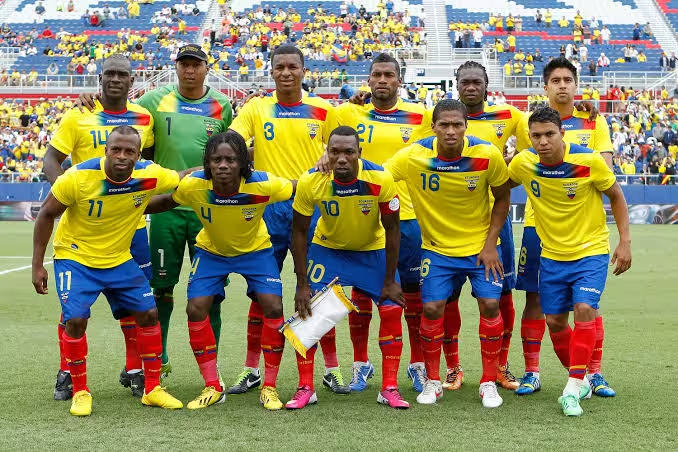
Following a highly successful modern technical modernization under experienced technical management, La Tri enter the current international landscape as an elite global competitor. Blending a world-class, multi-championship European club defensive core with an incredibly fast wave of young attacking talent, Ecuador stands as a complex and highly demanding challenge for global opponents. This comprehensive profile breaks down the structural design of the active senior roster, foundational history, individual records, and up-to-date statistical performance data.
Brief History and Core Continental Achievements
The Ecuadorian Football Federation was officially founded in 1925 and admitted to FIFA in 1926, later joining CONMEBOL in 1927. While La Tri spent the mid-20th century building their domestic league infrastructure, the turn of the 21st century sparked a monumental revolution that completely altered the trajectory of the sport within the country.
The Millennium Breakthrough and Continental Solidification
Ecuador’s foundational breakthrough arrived during the 2002 FIFA World Cup qualification cycle, where a legendary generation spearheaded by Agustín Delgado and Alex Aguinaga shocked the hemisphere to secure the nation’s maiden voyage to the global stage. On their home continent, Ecuador has consistently established a highly competitive pedigree, twice achieving fourth-place finishes at the Copa América and turning their high-altitude fortress in Quito into one of the most feared environments in international sports. They further cemented their modern pedigree by qualifying for four of the last six FIFA World Cup final tournaments, establishing a permanent baseline of global excellence.
Technical Roster Breakdown (2026 Campaign)
The modern Ecuadorian squad operates primarily within a highly disciplined, compact 3-4-2-1 or a fluid, high-pressing 4-3-3 formation. The system places an absolute premium on extreme vertical width from wing-backs, high-intensity athletic pressing traps in the middle third, and lightning-fast vertical transitions through the half-spaces.
1. Goalkeepers
The Ecuadorian goalmouth requires exceptional close-range reflex capabilities, commanding box organization during set-piece phases, and rapid sweeping traits out of the penalty box.
- Hernán Galíndez (#1): The preferred first-choice starting goalkeeper. Galíndez brings immense veteran calmness, world-class positioning, and an exceptional history of clutch, acrobatic tournament saves.
- Alexander Domínguez (#22): A towering, legendary veteran shot-stopper providing elite starting-caliber depth and locker-room leadership from the bench.
- Moisés Ramírez (#12): A sharp, highly agile young keeper finalizing a highly secure and deeply experienced goalkeeping department.
2. Defenders
The defensive backline is the absolute foundation of La Tri, engineered for absolute recovery speed, rugged sliding tackles, and precise tactical positioning.
- Piero Hincapié (#3): The preferred central defensive anchor and global icon. Operating at the highest elite European club level, Hincapié provides world-class recovery speed, robust physical tackling power, and exceptional left-footed passing distribution out of the backline.
- Willian Pacho (#6) & Félix Torres (#2): Top-tier central defenders who partner Hincapié to form a highly cohesive structural shield, providing an exceptional mixture of physical height and ground pace.
- Pervis Estupiñán (#7): The vice-captain and a world-class left-back. Operating as a relentless wing-back, Estupiñán provides blistering vertical speed, elite 1v1 wide crossing lines, and immense tactical progression.
- Angelo Preciado (#17) & Joel Ordóñez (#4): Highly dynamic, attack-minded right-backs responsible for executing overlapping combinations and cutting inside to generate overloads.
- Jackson Porozo (#15) & Jhoanner Chávez (#14): Disciplined, tactically sound defensive depth options built for rugged tournament battles.
3. Midfielders
The midfield is the absolute tactical engine room of La Tri, combining unparalleled physical stamina with press-resistant ball retention and high-volume ball-winning metrics.
- Moisés Caicedo (#23): The captain, superstar maestro, and undisputed heartbeat of the team. Operating as the premier box-to-box engine, Caicedo utilizes world-class press-resistance, visionary passing range, and ferocious tackling metrics to completely dominate the center circle.
- Carlos Gruezo (#8) & Alan Franco (#21): Robust, tireless central anchors responsible for executing high-volume tackles, clogging central passing channels, and protecting the central defenders.
- Kendry Páez (#10): The prodigiously gifted young superstar playmaker. Operating between lines, Páez possesses world-class close-control dribbling, extraordinary vision, and a lethal left-footed shooting threat inside the final third.
- John Yeboah (#11) & Jeremy Sarmiento (#16): Highly energetic, creative progressive outlets tasked with finding pockets of space and executing rapid transitions out wide.
4. Forwards
The frontline provides a highly flexible mixture of direct transitional speed, intense front-line defensive pressing, and immense physical target presence.
- Enner Valencia (#13): The captain, all-time legend, and talismanic leader. Valencia operates as a lethal central forward or drifting wide, utilizing clinical final-third execution, elite aerial power, and a legendary record for scoring tournament goals.
- Kevin Rodríguez (#19) & Jordi Caicedo (#9): Highly dynamic, physically robust central strikers chosen to lead the line, hold up long distributions, and wear down opposition center-backs.
- Gonzalo Plata (#20) & Janner Corozo (#18): Blistering, exceptionally fast wide forwards deployed to stretch opposing backlines and cut inside to generate rapid shooting angles.
FIFA World Cup Performance Statistics
Ecuador’s statistical resume at the FIFA World Cup highlights an international program that stands as one of South America’s most regular modern competitors, amassing four final tournament finishes.
World Cup Tournament History Dashboard
The table below logs Ecuador’s absolute performance metrics across their completed FIFA World Cup final appearances:
| World Cup Edition | Host Countries | Overall Record (W-D-L) | Goals (GF-GA) | Final Tournament Milestone / Result |
|---|---|---|---|---|
| 2002 | South Korea / Japan | 1-0-2 | 2-4 | Group Stage Exit (World Cup Debut) |
| 2006 | Germany | 2-0-2 | 5-4 | Round of 16 Exit (Highest Tournament Finish) |
| 2014 | Brazil | 1-1-1 | 3-3 | Group Stage Exit (Defeated Honduras 2-1) |
| 2022 | Qatar | 1-1-1 | 4-3 | Group Stage Exit (Opened Tournament with 2-0 Win) |
| Historical Totals | 4 Tournaments Entered | 5-2-6 | 14-14 | 1x Knockout Stage Appearance |
Legendary Individual Records and Milestones
The history of La Tri is built upon pioneering goalscorers and dedicated international veterans who set the absolute highest standards for Ecuadorian sports.
All-Time Cap and Scoring Leaderboards
The tables below document the historical all-time record holders for senior international appearances and goals scored for the Ecuadorian men’s national team:
| Rank | Most Capped Players | Total International Caps | Career Era | Goals Scored |
|---|---|---|---|---|
| 1 | Iván Hurtado | 168 | 1992–2014 | 5 |
| 2 | Walter Ayoví | 122 | 2001–2017 | 8 |
| 3 | Édison Méndez | 112 | 2000–2014 | 18 |
| 4 | Enner Valencia | 89 | 2012–Present | 43 |
| 5 | Alex Aguinaga | 109 | 1987–2004 | 16 |
| Rank | All-Time Top Goalscorers | Goals Scored | Matches Played | World Cup Goals |
|---|---|---|---|---|
| 1 | Enner Valencia | 43 | 89 | 6 (National Record) |
| 2 | Agustín Delgado | 31 | 71 | 3 |
| 3 | Eduardo Hurtado | 26 | 74 | 0 |
| 4 | Christian Benítez | 24 | 58 | 0 |
| 5 | Alex Aguinaga | 16 | 109 | 0 |
Elite Individual Benchmarks
- The World Cup Scoring Peak: Forward Enner Valencia holds the absolute national record for the most goals scored at FIFA World Cup finals with 6 goals, establishing himself as one of the most efficient tournament strikers in South American history by netting all of Ecuador’s goals across consecutive World Cup appearances.
- The Untouchable Cap Record: Legendary central defender Iván Hurtado stands entirely alone at the apex of Ecuadorian sports history, amassing an extraordinary 168 international caps to sit comfortably among the most capped male footballers of all time.
Tactical Identity: High-Intensity Pressing and Blistering Width
The contemporary tactical blueprint of La Tri operates primarily out of a highly flexible, physically overwhelming 3-4-2-1 matrix. The cornerstone of the entire system is spatial compression through high-volume athletic duels. Ecuador utilizes the world-class engine room of Moisés Caicedo to aggressively force turnovers in the middle third, completely suffocating opposition progression routes.
When transitioning to attack, Ecuador completely avoids slow possession build-ups inside their own half. Deep pivots immediately skip midfield lines, looking to feed the ball wide to release the blistering horizontal acceleration of Pervis Estupiñán. This movement triggers an immediate wide overload phase, as fullbacks stretch the opposition backline to create massive pockets for inverted playmakers like Kendry Páez to slide diagnostic balls straight through to central strikers, transforming deep defensive containment into clinical final-third execution.
Conclusion
The Ecuador national football team stands as a magnificent testament to long-term structural organization, extreme athletic pace, and tactical maturity. Their highly organized, high-speed transitional framework highlights an international program masterfully engineered to systematically neutralize and exploit the defensive shapes of global football giants. As Moisés Caicedo coordinates midfield tempos from the center circle and Piero Hincapié enforces defensive containment, La Tri possess every structural asset necessary to maintain their historic reputation as an ascending force in global football.