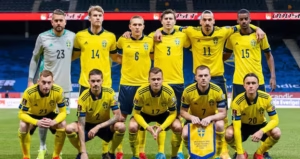
The Switzerland national football team, historically and culturally known across the sporting landscape as the Nati (The National Team), represents one of Europe’s most structurally resilient, consistent, and tactically sophisticated programs. Known for an elite footballing blueprint that combines defensive organization, a highly technical midfield axis, and extreme mental composure under tournament pressure, Switzerland has evolved into a permanent fixture in the deep knockout phases of major international competitions.
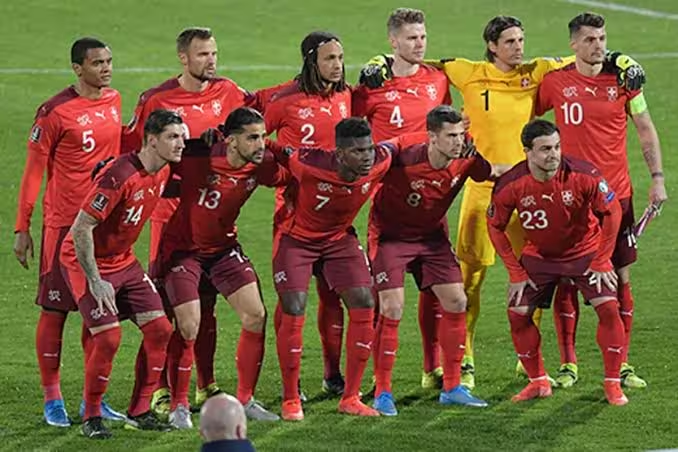
Following a highly competitive preliminary cycle, the Nati enters the current footballing landscape as a formidable threat capable of dismantling any global superpower. With a roster meticulously balancing legendary, multi-tournament veteran leaders with a fast, dynamic wave of young talent playing in Europe’s top domestic leagues, Switzerland stands as a demanding challenge for global opponents. This comprehensive profile breaks down the structural design of the active senior roster, foundational history, individual records, and updated tournament data.
Brief History and Core Continental Achievements
While the Swiss Football Association was founded in 1895 as one of the oldest governing bodies in continental Europe, the nation established its initial global footprint by securing a silver medal at the 1924 Summer Olympics in Paris.
Modern Continental Powerhouse Status
In the modern era, Switzerland has transformed into an undeniable European force, qualifying for nearly every major international tournament over the past two decades. Their crowning breakthrough on the continental stage occurred during UEFA Euro 2020, where they produced a historic knockout performance to eliminate reigning world champions France in a dramatic penalty shootout, marching into the Quarter-finals. They further cemented their elite tournament pedigree at UEFA Euro 2024 in Germany, putting on a tactical masterclass to defeat holders Italy before bowing out narrowly in the Quarter-finals on penalties, establishing a supreme baseline for their modern international campaigns.
Technical Roster Breakdown
The modern Swiss squad functions within a highly structured, tactically flexible 3-4-2-1 or a classic, compact 4-3-3 formation. The system places a massive premium on absolute defensive containment, fluid possession recycling through deep internal pivots, and lethal vertical width generated by overlapping wing-backs.
1. Goalkeepers
The Swiss goal area represents one of the most elite, secure departments in international football, anchored by a shot-stopper renowned for world-class reflex capabilities and leadership.
- Yann Sommer (#1): The active first-choice starting goalkeeper and long-serving protector of the national team. Sommer brings world-class positioning, exceptional short-range reflex stopping, and a historic reputation for saving penalties in high-stakes tournament moments.
- Gregor Kobel (#12): One of the premier young goalkeepers in European club football, providing elite starting-caliber depth and immense physical command from the bench.
- Yvon Mvogo (#21): An incredibly athletic, reliable shot-stopper finalizing a world-class goalkeeping department.
2. Defenders
The defensive line focuses on supreme spatial awareness, technical composure when distributing out of pressure, and intense physical tackling metrics.
- Manuel Akanji (#5): The defensive anchor and undisputed leader of the backline. Operating at the absolute highest European club level, Akanji provides world-class recovery speed, exceptional reading of passing lines, and elite tactical distribution out of the back.
- Nico Elvedi (#4) & Ricardo Rodríguez (#13): Experienced central defenders who form a highly cohesive, tactically sound partnership alongside Akanji, with Rodríguez providing excellent left-footed balance.
- Fabian Schär (#22): A robust, physically imposing center-back renowned for his aerial dominance, long-range passing lines, and threat on offensive set-pieces.
- Silvan Widmer (#3) & Leonidas Stergiou (#2): High-energy, tactically disciplined fullbacks responsible for providing width in transition and executing quick recovery tracking.
- Cédric Zesiger (#15): A physically dominant central defensive depth option built for rugged tournament battles.
3. Midfielders
The midfield functions as the absolute tactical engine room, meticulously balancing deep possession-oriented orchestration with an intense mid-block press.
- Granit Xhaka (#10): The captain, all-time icon, and undisputed heartbeat of the team. Xhaka is the ultimate midfield general, utilizing world-class press-resistance, visionary passing range, and positional authority to dictate the exact tempo of matches.
- Remo Freuler (#8): A tireless, elite box-to-box engine. Freuler provides relentless lateral coverage to plug central passing lines, intercept opposition transitions, and execute late attacking runs.
- Denis Zakaria (#6) & Michel Aebischer (#20): Physically robust, technically secure deep pivots deployed to absorb central overloads and recycle possession under heavy opposition pressure.
- Xherdan Shaqiri (#23): The legendary creative talisman. Operating as an advanced playmaker between the lines, Shaqiri possesses world-class dead-ball execution, vision, and a historic pedigree for scoring spectacular tournament goals.
4. Forwards
The frontline provides an aggressive mixture of direct vertical speed, intense front-line pressing, and dynamic attacking versatility.
- Breel Embolo (#7): The premier central forward leading the attack. Embolo offers immense physical power, excellent hold-up capabilities to bring wingers into play, and a continuous vertical threat behind opposition backlines.
- Ruben Vargas (#11) & Dan Ndoye (#19): Exceptionally fast, dynamic inside-forwards who thrive when isolating fullbacks in 1v1 situations in the final third.
- Zeki Amdouni (#9) & Noah Okafor (#14): Highly technical, versatile attacking options utilized to shift forward depths and inject rapid transitional flair.
- Kwadwo Duah (#17): A clinical, high-intensity forward variant chosen to wear down opposition center-backs in high-stakes moments.
FIFA World Cup Performance Statistics
Switzerland’s statistical resume highlights one of the most consistent global records, having reached the Quarter-finals on three historic occasions and regularly qualifying for the knockout rounds in the modern era.
| World Cup Edition | Host Country / Nations | Overall Record (W-D-L) | Goals (GF-GA) | Final Tournament Milestone / Result |
|---|---|---|---|---|
| 1934–1954 | Various Countries | 6-0-9 | 28-39 | 3x World Cup Quarter-finalists (1934, 1938, 1954) |
| 1962–1966 | Chile / England | 0-0-6 | 3-17 | 2x Consecutive Group Stage Exits |
| 1994 | United States | 1-1-2 | 5-7 | Round of 16 |
| 2006 | Germany | 2-2-0 | 4-0 | Round of 16 (Eliminated on Penalties Without Conceding a Goal) |
| 2010 | South Africa | 1-1-1 | 1-1 | Group Stage Exit (Only Team to Defeat Champions Spain) |
| 2014 | Brazil | 2-0-2 | 7-7 | Round of 16 |
| 2018 | Russia | 1-2-1 | 5-5 | Round of 16 |
| 2022 | Qatar | 2-0-2 | 5-9 | Round of 16 |
| Historical Totals | 12 Tournaments Entered | 17-8-25 | 66-95 | Highest Placement: Quarter-finals (1934, 1938, 1954) |
Legendary Individual Records and Milestones
The history of the Nati is written by modern icons and dedicated tournament veterans who have set elite individual benchmarks for European football longevity.
All-Time Cap and Scoring Leaderboards
The tables below document the historical all-time record holders for senior international appearances and goals scored for the Swiss men’s national team:
| Rank | Most Capped Players | Total International Caps | Career Era | Goals Scored |
|---|---|---|---|---|
| 1 | Granit Xhaka | 125 | 2011–Present | 14 |
| 2 | Xherdan Shaqiri | 123 | 2010–Present | 32 |
| 3 | Heinz Hermann | 118 | 1978–1991 | 15 |
| 4 | Ricardo Rodríguez | 115 | 2011–Present | 9 |
| 5 | Alain Geiger | 112 | 1980–1996 | 5 |
| Rank | All-Time Top Goalscorers | Goals Scored | Matches Played | Career Goal Ratio |
|---|---|---|---|---|
| 1 | Alexander Frei | 42 | 84 | 0.50 |
| 2 | Kubilay Türkyilmaz | 34 | 62 | 0.55 |
| 3 | Max Abegglen | 34 | 68 | 0.50 |
| 4 | Xherdan Shaqiri | 32 | 123 | 0.26 |
| 5 | André Abegglen | 29 | 52 | 0.56 |
Elite Individual Records
- The Ultimate General: Captain Granit Xhaka stands as the undisputed most-capped player in the history of Swiss football, cementing his legacy as one of Europe’s most durable and influential modern midfielders.
- The Unique Tournament Record: Winger Xherdan Shaqiri holds an extraordinary global record, being one of the few players in football history to have scored in six consecutive major international tournaments (spanning World Cups and European Championships from 2014 through to 2024).
Tactical Identity: The Swiss Structural Matrix
The tactical template of the Nati operates as a highly coordinated, possession-oriented machine. The cornerstone of the entire system is structural patience. Rather than rushing transitions, Switzerland utilizes the world-class press-resistance of Granit Xhaka and Remo Freuler to comfortably recycle possession deep in the middle third, methodically forcing the opposition’s defensive shape out of position.
Out of possession, Switzerland abandons frantic, disconnected pressing triggers, favoring a highly synchronized, compact mid-block shape. Manuel Akanji commands the line with absolute precision, compressing the space between the midfield and defensive structures to trap central attacking players. Once a turnover is secured, the Nati strikes with calculated efficiency, using deep vertical distributions outward to rapid wide weapons like Dan Ndoye or hitting Breel Embolo directly for physical hold-up sequences, transforming defensive containment into surgical final-third execution.
Conclusion
The Switzerland national football team represents a magnificent blend of tactical discipline, elite individual longevity, and modern European pedigree. Their highly organized, possession-oriented style highlights an international program masterfully engineered to systematically neutralize and pick apart the game plans of global football giants. As Granit Xhaka orchestrates tempos from the center circle and Manuel Akanji locks down the backline, the Nati possesses all the structural cohesion, technical parameters, and competitive toughness necessary to permanently challenge the absolute upper echelon of the global game.