The Czechia national football team, historically and culturally revered as the Národní tým (The National Team), represents one of Central Europe’s most tactically sophisticated and structurally resilient footballing programs. Inheriting the grand footballing lineage of Czechoslovakia, Czechia has consistently carved out a reputation as a highly organized, physically imposing, and technically efficient side capable of dismantling global superpowers.
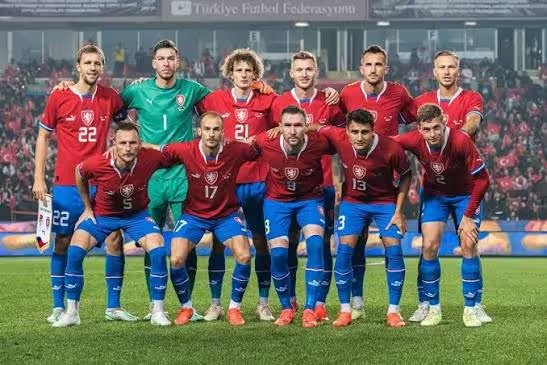
Following a highly competitive European qualification cycle under a new coaching regime, the Národní tým has entered the 2026 FIFA World Cup as a formidable competitor. Blending world-class, physically dominant Bundesliga and Premier League veterans with an incredibly dynamic wave of technical young talent, Czechia stands as a demanding challenge for international opponents. This comprehensive review breaks down the structural design of the active 2026 roster, historical milestones, individual records, and up-to-date tournament data.
Brief History and Core Continental Achievements
While the Czech Republic national team officially began competing under its independent banner in 1994, it inherited a rich historical tapestry from Czechoslovakia, which captured the 1976 UEFA European Championship and finished as FIFA World Cup runners-up in 1934 and 1962.
Modern Continental Consistency
As an independent nation, Czechia instantly established a golden footprint on the global map during their debut tournament at UEFA Euro 1996 in England, marching spectacularly to the Final before earning the silver medal. They proved this pedigree was a permanent asset by reaching the Semi-finals at Euro 2004 with an iconic, fluid attacking team and consistently advancing deep into the knockout phases of subsequent European Championships, establishing a standard of elite tactical execution on the continent.
Technical Roster Breakdown (2026 Campaign)
The modern Czech squad sets up inside a robust, highly structured 3-4-2-1 or a classic 4-2-3-1 shape. The system relies heavily on absolute aerial dominance, an intense mid-block press, and rapid vertical transitions utilizing overlapping wing-backs.
1. Goalkeepers
The Czech goal area requires exceptional height, commanding box presence, and supreme shot-stopping capabilities under heavy aerial pressure.
- Jindřich Staněk (#1): The active starting goalkeeper at the 2026 finals. Staněk brings world-class reflexes, physical dominance in the six-yard box, and excellent penalty-saving record.
- Matěj Kovář (#16): A highly talented, modern ball-playing keeper providing elite starting-caliber depth from the bench.
- Vítězslav Jaroš (#23): A sharp, young backup keeper finalizing the squad’s exceptionally deep goalkeeping reserves.
2. Defenders
The defensive line is engineered for absolute physical dominance, combining immense height and robust tackling power with composed ball distribution.
- Tomáš Holeš (#3) & Robin Hranáč (#4): The preferred central defensive pairing, offering imposing physical profiles, high clearance metrics, and clean tactical interception lines.
- Ladislav Krejčí (#5): A highly versatile, goal-scoring defender who excels at reading passing lanes and organizing structural shapes from the back.
- Vladimír Coufal (#5): The veteran right-back, providing relentless two-way work rates, tough defensive tracking, and elite crossing capabilities.
- David Douděra (#12) & Martin Vitík (#6): Highly dynamic, modern wide fullbacks responsible for providing transition options and high-volume crossing lines.
- Tomáš Vlček (#2) & David Zima (#15): Disciplined central defensive depth options built to handle physical tournament battles.
3. Midfielders
The midfield functions as the absolute engine room, meticulously balancing intense defensive screening duties with progressive, line-breaking passing.
- Tomáš Souček (#22): The captain, primary deep pivot, and undisputed tactical heartbeat of the team. Souček provides elite box-to-box engine work, tireless ball-winning capabilities, and world-class aerial threat on offensive set-pieces.
- Lukáš Provod (#14): A highly dynamic, versatile midfielder favored to partner Souček in controlling possession tempos and driving transitions.
- Antonín Barák (#7) & Pavel Šulc (#18): Creative, high-IQ attacking midfielders tasked with operating between lines and executing final-third combinations.
- Ondřej Lingr (#13) & Alex Král (#21): Energetic, high-intensity pressing options deployed to disrupt opposition central build-ups.
4. Forwards
The frontline provides a devastating mixture of elite target presence, physical hold-up capabilities, and clinical final-third finishing.
- Patrik Schick (#10): The premier central striker leading the line. Schick offers world-class movement, elite aerial power, and clinical finishing skills with both feet.
- Adam Hložek (#9): A highly dynamic inside-forward providing explosive transitional power, direct dribbling lines, and long-range shooting threat.
- Jan Kuchta (#11) & Mojmír Chytil (#19): Physically robust, high-volume pressing strikers chosen to wear down opposition center-backs.
- Tomáš Chorý (#17): A towering, physical wildcard target man utilized to alter attacking directness late in matches.
FIFA World Cup Performance Statistics
Czechia's statistical resume highlights a program aiming to match their unparalleled European Championship consistency with deep global tournament runs.
World Cup Tournament History Dashboard
The table below logs Czechia’s absolute performance metrics across their independent FIFA World Cup final appearances:
| World Cup Edition | Overall Record (W-D-L) | Goals (GF-GA) | Final Tournament Milestone / Result |
|---|---|---|---|
| 2006 | 1-0-2 | 3-4 | Group Stage Exit (Independent Debut) |
| 2026 | 1-1-0 (Active) | 2-1 | Group Stage Performance |
| Historical Totals | 2-1-2 | 5-5 | Inherited 2x Silver Medals from Czechoslovakia |
The Active 2026 World Cup Campaign
Czechia successfully navigated a grueling European qualification cycle to secure their place at the expanded finals in North America. Competing in a deeply tactical Group Stage, the Národní tým has displayed typical structural resilience.
- The Group Opener: Czechia kicked off their tournament campaign with a highly disciplined 1-0 victory, using an organized defensive block to earn an ideal start.
- The Second Matchday: In their second group fixture, Czechia engaged in a physical battle, playing out a tense 1-1 draw to keep their knockout qualification targets firmly in their own hands.
With 4 points accumulated, Czechia sits in prime position to safely book passage into the expanded Round of 32 knockout stages ahead of their final group stage showdown.
Legendary Individual Records and Milestones
The history of Czech football is built upon legendary world-class icons and dedicated tournament veterans who established elite individual benchmarks.
All-Time Cap and Scoring Leaderboards
The tables below document the historical independent all-time record holders for senior international appearances and goals scored for the Czech men’s national team:
| Rank | Most Capped Players | Total International Caps | Career Era | Goals Scored |
|---|---|---|---|---|
| 1 | Petr Čech | 124 | 2002–2016 | 0 |
| 2 | Karel Poborský | 118 | 1994–2006 | 8 |
| 3 | Tomáš Rosický | 105 | 2000–2016 | 23 |
| 4 | Jaroslav Plašil | 103 | 2004–2016 | 7 |
| 5 | Milan Baroš | 93 | 2001–2012 | 41 |
| Rank | All-Time Top Goalscorers | Goals Scored | Matches Played | Career Goal Ratio |
|---|---|---|---|---|
| 1 | Jan Koller | 55 | 91 | 0.60 |
| 2 | Milan Baroš | 41 | 93 | 0.44 |
| 3 | Vladimír Šmicer | 27 | 81 | 0.33 |
| 4 | Patrik Schick | 22 | 44 | 0.50 |
| 5 | Tomáš Rosický | 23 | 105 | 0.22 |
Elite Individual Records
- The Golden Boot Pedigree: Striker Milan Baroš won the UEFA Euro 2004 Golden Boot with 5 goals, while Patrik Schick finished as the joint-top scorer at UEFA Euro 2020 with 5 goals, highlighting a rich tradition of elite tournament strikers.
- The Towering Benchmark: Legendary target man Jan Koller remains the undisputed all-time top goalscorer in Czech international history, netting 55 goals over a historic decade.
Tactical Identity: The Czech Structural Template
The tactical blueprint of the Národní tým revolves around a high-intensity, physically robust philosophy operating out of a fluid 3-4-2-1 structure. The foundational system aims to compress central channels, using the physical anchoring properties of Tomáš Souček to choke opposition progression lines.
When transitioning to attack, Czechia relies heavily on wide overloads. Fullbacks like Vladimír Coufal push high up the pitch to deliver precise, high-volume crosses into the box, maximizing the immense aerial height and physical power of Patrik Schick and Tomáš Souček. This aggressive wing strategy, combined with a highly organized set-piece protocol, turns Czechia into an incredibly direct, dangerous threat in the final third.
Conclusion
The Czechia national football team represents a magnificent blend of historic Central European prestige, physical power, and tactical discipline. Their organized performances at the 2026 World Cup showcase a team perfectly engineered to handle the physical demands of global tournament football. As Tomáš Souček coordinates the squad under immense international expectation, the Národní tým possesses all the structural attributes necessary to challenge the world’s best on the global stage.